


Review Article
Volume-1 Issue-1, 2021
Coordination Modes of Hydroxamic Acids in Tin - An Overview
Received Date: January 16, 2022
Accepted Date: February 16, 2022
Published Date: February 17, 2022
Journal Information
Abstract
This review focuses on the synthesis, structural study and application of hydroxamic acid (HAs) and its complexes with organotin (IV) to produce organotin (IV) hdroxamate. Organotin (IV) compounds have received great attention in research field as a photostabilizer in PVC and its application in different aspect, such as marine (in anti-fouling paints and coatings for the protection of ship hulls) and as precursors for SnO2-coatings on glass and in biological field.
Different studies done by researchers highlighted on the organotin (IV) complexes and its applications, and in our study we summarise some of these studies. All information collected by these studies have received great interest and have a vital role in many applications.
Key words
Hydroxamic Acids
 |
| Figure 1: Conversion of Acid Chloride to Hydroxamic Acid |
 |
| Figure 2:Conversion of Esters to Hydroxamic Acid |
 |
| Figure 3:Conversion of para-Carboxylic Acid to Hydroxamic Acid using Triphenyl Phosphine and N bromosuccinimide in Presence of A mild Base Like Triethyl Amine |
 |
| Figure 4: Conversion of Carboxylic Acid under Natural Conditions |
 |
| Figure 5: Reaction of Ester in an Alkaline Condition |
 |
| Figure 6: Structures of Hydroxamic Acids |
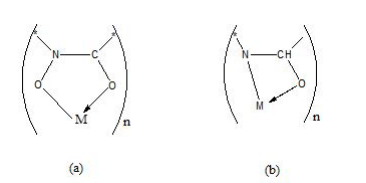 |
| Figure 7: Two coordination mode of hydroxamic acid |
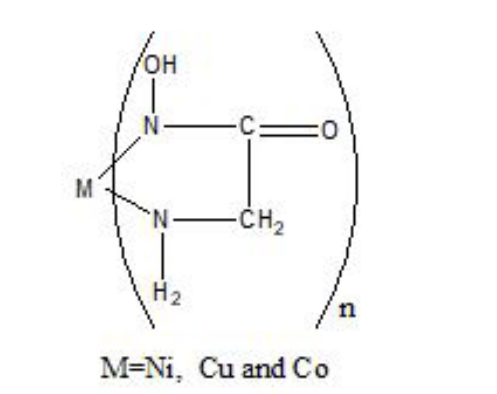 |
| Figure 8: Structure of Transition Metal of Glycinhydroxamic Acid |
Hydroxamic Acid
Hydroxamic acids are known as one of the key classes of naturally occurring compounds that play a part in many biological systems [1-3] hydroxamic acids also act as metal complexing agents [4-9]. Much of the activity of these compounds is traceable to the presence of the hydroxamic acid group that allows them to chelate to metal ions and mostly with iron [10] which is the most abundant transition metal ion in humans. The biological activity and the chemistry of these compounds make it essential for different applications such as, medical, bio and analytical chemistry [11-13].
Hydroxamic acid is an oxygen donor ligand possessing an affinity for a variety of metal ions [14]. Numerous papers showed that mono hydroxamic acids adopt a typical binding mode and X-ray diffraction study of the benzohydroxamic acids complex of iron(III) [15] has disclosed that the chelation of hydroxamic acid involves the oxygen atoms belonging to the carbonyl and hydroxylamine groups. Hydroxamic acid have become much popular for their biochemical applications in recent years due to the display of a wide range of biological activities, which may be ascribed to their chelating properties with metal ion [6].
The chemistry of HA and their derivatives have received significant interest because of their pharmacological, toxicological and pathological properties since 1959 which is the year of discovery of hydroxamic acids by Wahtroos and Virtanen [16]. Hydroxamic acids play a vital role in many biologically related interactions and its derivatives have a variety of pharmaceutical properties. Recently, the use of peptide and pseudo peptide HA as inhibitors of the matrix metalloproteinase (MMPs) has gained a significant interest especially for cell proliferation [17].
Hydroxamic acids considered low toxic and exhibit a widespread range of applications different field of biological systems such as, tumor inhibitors, antimicrobial agents, anti-tuberculous agents as well as anti-leukemic agents and are a key pharmacophore in a different chemotherapeutic agents, cell-division factors and pigments. Hydroxamic acids have been reported in human medical, for examples pharmaceutical drugs for the treatment of variety of illnesses.
Hydroxamic acids (HAs) are possess chelating mediators for mono-, di- and trivalent metal ions. [18], and also reported as potentially effective corrosion inhibitors for copper [19]. Hydroxamic acids are also known as reducing agents, but they also react as a ligand of di-oxygen chelating agent [20]. Hard-acid cations, and their reactions with iron and other metals have giant a high attention in several scientific areas.
HAs may form complexes with different metal ions, mainly iron (III) and the polymers having hydroxamic acid groups are utilized in metal-ion preconcentration and separation [21]. Furthermore, there is renewed and growing biochemical interest in hydroxamic acids because they have been found to accumulate in natural products [22].
The use of polyhydroxamic acid ion exchange resins for the removal and separation of metal ions has been established. Commercially, chelating ion exchanger is still not available. The ion exchanger resin has been synthesized by either polymerization of monomers containing hydroxamic acid group or by converting the functional groups of ester, amide, carboxylic acid, nitrile, or maleic acid in a polymer into the hydroxamic acid. Treatment of ester with hydroxylamine is a universal method to prepare HAs [23]. The presence of the HAs groups in the polymer solution can be confirmed by the formation of a dark violete colour according to the presence of vanadium ions in the reaction solution. These groups come into existence as the product of decomposition of the HAs and hydrolysis of the ester functional groups in concentrated basic solution under preparative conditions [24].
Organotin Hydroxamates
Interest in the coordination chemistry of organotin (IV) derivatives towards hydroxamic acids has become important mainly because of its reactivity, the unique structural features and antitumour/antitumour applications. In recent years organotin hydroxamates were studies with attention on the synthesis, investigation of physicochemical properties as well as their structures.
Coordination chemistry of organotin (IV) derivatives towards hydroxamic acids has attained significant cosideration mainly due to the reactivity, the remarkable structural features and their activity against cancer. A wealth of studies on organotin hydroxamates pertaining to synthesis, analysis of physicochemical properties as well as structures have been the matter of great interest. In general, the hydroxamate anion exhibits bidentate chelating ability due to the carbonyl coordination to tin. However, the reports available in literature on X-ray structure determinations of organotin N- meta substituted hydroxamates are very few [25-28]. It is thus imperative that structural investigation on such complexes are carried out.
Synthetic Methods
Synthesis of Hydroxamic Acids
Hydroxamic acids are used in the preparation of a wide range of heterocyclic compounds [29] Hydrxamic acids are usually found as white solids with the exception of the nitro-and iodo-substituted derivatives exhibiting pale yellow and light pink colours, respectively. Several techniques are reported for synthesizing hydroxamic acids.
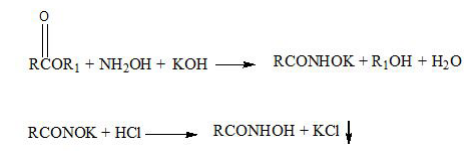
Among the common techniques are the conversion of methyl or ethyl esters of carboxylic acids to hydroxamic acids via the formation of potassium hydroxamate salt [30-32] (Figure 1). The production of hydroxamic acids from is depicted in Figure 2 acid chlorides using hydroxylamine in the presence of sodium hydrogen [33]. The hydroxamic acids can also be synthesised by intramolecular photorearrangement of alkane nitronate anions [34], and para-substituted benzoic acid by using hydroxylamine hydrochloride in the presence of triphenyl phosphine and N-bromosuccinimide under mild basic conditions [35] (Figure 3). Lastly Figure 2.4 is a one-step conversion of carboxylic acid to hydroxamic acid, under neutral pH condition [36].
Some type of biosynthesis production of hydroxamic acids is
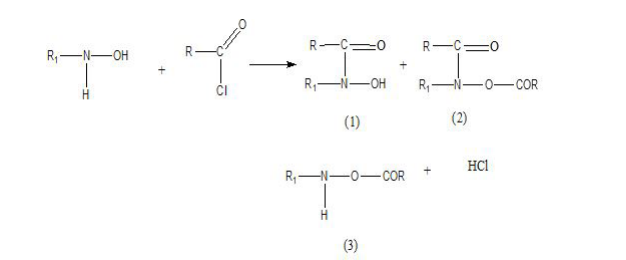
also reported [37]. A range of enzymes can be used to synthesize different types of hydroxamic acids under mild reaction conditions (pH 7-8, temperature below 50 o C, aqueous media and biological catalysts). Acylation of hydroxaylamine is a common practice for the preparation of primary monohydroxamic acids. The usual acylating agent may be used successfully in the preparation of monohydroxamic acids e.g. anhydrides, acid chlorides and esters etc. However, the use of esters are more common in practice. As a result of the reaction of N-aryl hydroxylamine with an acid chloride, both of its hydrogen atoms are targeted concurrently producing mono (1) and di-(2) substituted derivatives as shown in Figure 4. However such techniques require tedious methods of purifications, including extraction with ammonia [38,39]. Esters react particularly in a strong alkaline medium to form the salt of the required acid in the synthesis of hydroxamic acid and the hydroxamic acid is produced by acidification by passing the formation of diacyl derivatives which may be significant of even dominant when acid chloride or anhydrides are used.
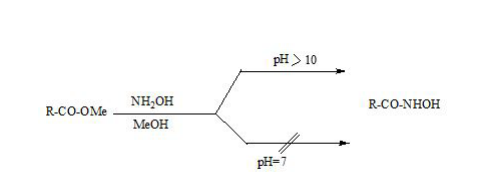
Preparation of the acid chloride is often tiresome when some labile functional groups of other acids are present along with the substrate and further acylation is unavoidable during the reaction with hydroxylamine. From the literature, the neutral condition are not favourable for the reaction of hydroxylamine with esters as shown in Figure 5 and always needs an alkaline condition (pH< 10). Hence, this method is not suitable for ester derivatives containing halides, esters and other base-sensitive groups.
Synthesis of Organotin (IV) Hydroxamtes
Different methods are enlisted for the syntheses of organotin(IV) hydroxamates e.g. From the condensation reaction of the appropriate diorganotin(IV) oxides or tri-organotin(IV) hydroxides with the free hydroxamic acids in molar ratios of 1:2 and 1:1 for di-and tri- organotin(IV) complexes respectively as; Equations
R2SnO + 2R’CONR”OH R2Sn (R’CONR”O)2 + 2H2O
R3SnOH + R’CONR’OH R3SnR’CONR’O + H2O
A replacement reaction of diorganotin(IV) dichloride and trioganotin(IV) chloride using appropriate free ligand with the same molar ratio mentioned above in the presence of triethylamine. However, the liberated HCl can be removed by using triethylamine, as the amine hydrochloride from the reaction mixture, which also serves as the driving force for the reaction [40];
R2SnCl2 + 2R’CONR”OH + 2(C2H5)3N R2Sn (R’CONR”O)2 +2(C2H5)5-HCl
R3SnCl + R’CONR”OH + (C2H5)3N R3SnR’CONR”O + (C2H5)2-HCl
Use of diorganotins(IV) oxides and the free ligand with molar ratio 1:2 in the presence of excess 2,2 dimethoxypropane in chloroform at room temperature for 3-4 h has also been reported. The function of 2,2- dimethoxypropane is to absorb the water liberated from the reaction [41].
Structural Studies
Structure of Hydroxamic Acids
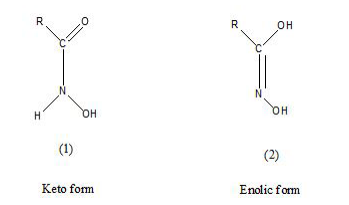
There are two key structures which have been put forward for hydroxamic acid are: (I) the keto form and (II) the enolic form as shown below in Figure 6:
Structure (I) contains one easily substitutable proton (monobasic). Structure (II) act as a dibasic acid being in position of the ability to lose two protons. This keto-enol tautomerism is responsible to create a number of sites, which are available for metal ion coordination. The structure (I) predominates in low pH or acidic solutions whereas; structure (II) is dominant in high pH or alkaline medium [42].
Hydroxamic acids being a bidentate ligand are able to meet all the requirements necessary for creation of metal complexes. In the metal chelates formed by hydroxamic acids, coordination is possible by the deprotonation of the OH group and the subsequent (O, O) coordination of carbonyl oxygen and deprotonated OH as confirmed by IR, UV and NMR. It is thus assumed that usually hydroxamic acid metal complexes may have the following structure as shown in Figure 7 in which the metal atom coordinate through the oxygen atoms [43].
The mode of bonding described above via the oxygen atoms has been confirmed by X-ray crystallography in a variety of metal complexes [44-46]. No examples of (N, O) coordination have yet been noticed showing the involvement of deprotonation of the NH group as shown in Figure 2.6. However, recently reported experimental and theoretical studies [47-49] for RCONHOH (R=H, CH3), are in support of the idea that these monohydroxamic acids are N acids in the gas phase. Presence of amino group in the hydroxamic acid could involve this group in the coordination and the nitrogen or oxygen atom of the - CONHOH group. Either five or six membered ring may produce aminohydroxamic acids, such as glycinhydroxamic acid (2-aminoacetohydroxamic acid) NH2CH2CONHOH which provided the first example of (N, N) coordination in [Ni(NH2CH2CONHOH)2] [50]. Other examples include the glycinhydroxamic acid complexes of CoII and CuII [51] as shown in Figure 8.
A number of aminohydroxamic acids are reported showing different coordination behaviour, that is (O, O) and (N, N) depending on the type of metal being chelated and on the pH of the solution [52] Mode of coordination of the ligand depends on the type of the ligand owing to electronic and steric effects and the addition of glycine will also contribute to different functionality.
Finally, many studies have been conducted on the structures of HAs in both solution and solid state. Factors such as polymorphism, tautomerism, geometrical isomerism, intra- and intermolecular H-bonding and proton exchange processes must be considered while understanding the mechanism [53].
Conclusion
The aim of this paper was to review the most important studies of organotin (IV) with hydroxamic acids and its applications, many studies have been done on organotin(IV) compound but still need more time to be work on this compounds to evaluate and found the specific applications in chemical and biological field.
It can be concluded from this review that, hydroxamic acids are very important chelating agents with versatile biological activity, in addition organotin (IV) compounds play vital role as a biocidal activities as well as agricultural and industrial applications.
References
- Neilands J (1967) Hydroxamic In Nature Science. Science 156: 1440-7.
- Sandler S, Karo W (1972) Organic Functional Group Preparation. Academic Press” New York, USA.
- Peter K, Corey L, Edwards B (2011) Hydroxamic acids (therapeutics and mechanism): chemistry, acyl nitroso, nitroxyl, reactive oxygen species, and cell signalling. Journal of Receptors and Signal Transduction 31: 10-9.
- Chidambaram MD (1978) Design Of Iron (III) Chelator I Oral Treatment of Anemia: Solution Properties and Absorption of Iron (III) Acetohydroxamate In: Anemia Rats Bioinog Chem 9: 225-75.
- Choudhuri S, Das D, Chatterjee R, Chowdhury J (1991) Antitumor Activity of Some Organotin Complexes Of Hydroxamic Acids Derived From Dibasic Carboxylic Acid. Chemotherapy 37: 122-7.
- Farkas E, Enyedy E, Micera G, Garribba E (2000) Coordination Modes of Hydroxamic Acids In Copper (II), Nickel(II) And Mixed-Ligand Complexes In Aqueous Solution. Polyhedron 19: 1727-36.
- Joseph N (1997) Complexes of Cyclocarbohydroxamic Acids with Cobalt(II) Nickel (II) and Copper(II). Trans Met Chem 22: 123-5.
- Santana M, Garcia G, Perez J, Molin E, Lopez G (2001) Mononuclear Hydroxamate Five-Coordinate Nickl(II) Complexes: Structural And Spectroscopic Characterization. Inorg Chem 40: 5701-3.
- Santos M, Grazina R, Pinto M, Farkas E (2001) Transition Metal Complexes of Two Imino-Dihydroxamic Acids. Inorg Chem Acta 321: 42-8.
- Raymond K (1990) Biomimetric Metal Encapsulation. Coord Chem Rev 105: 135-53.
- Bauer I, Exner O (1974) The Chemistry of Hydroxamic Acids and N-Hydroxyimides. Angew Chem 13: 376-84.
- Kehle H (1982) Chemistry and Biology of Hydroxamic Acids, New York, USA.
- Muri E, Nieto M, Sindelar R, Williamson J (2002) Hydroxamic Acids as Pharmacological Agents. Curr Med Chem 9: 1931-53.
- Barbara K, Kozlowski H, Farkas E (1992) “Hydroxamic And Aminohydroxamic Acids And Theory Complexes With Metal Ion. Coord.Chem.Rev., 114; 169-200.
- Lindner S.; Göttlicher D. and Molekülstruktur D (1992); “Eisen(III)-benzhydroxamat-Trihydrates”, Act Cryst, B 23 832.
- Harry L (194.) “The Hydroxamic Acids”, Chem. Rev., 33, 3, 209-56.
- Jialiang H.; Philippe E.; Van den S.; Qing-Xiang A. Sang and Ghislain O (2007) “Matrix metalloproteinase inhibitors as therapy for inflammatory and vascular diseases”, Nature Reviews Drug Discovery 6: 480-98.
- Kurzak B, Kozolowski H, Farkas E (1992) “Hydroxamic Acid And Aminohydroxamic Acids And Their Metal Complexes With Metal”, Ions. Coord. Chem. Rev. 114: 169-200.
- Shaban E, Kálmán J (1998) An investigation of copper corrosion inhibition in chloride solutions by benzo-hydroxamic acids”, 43, 159-163, 1998.
- Taylor R, May I, Wallwork A, Denniss I, Hill N, et al. (1998) “The Applications Of Formo-Aceto- Hydroxamic Acids Reprocessing”, J. Alloys And Comp. 534: 271-3.
- Barocas F, .Baroncelli G.; Biondi (1966) “The complexing power of hydroxamic acids and its effect on behaviour of organic extractants in the reprocessing of irradiated fuels—II: The complexes between benzohydroxamic acid and thorium, uranium (IV) and plutonium (IV)”, 28: 2961-2967.
- Bruce M. and Crumbliss L (1983) “Factors that influence siderophore-mediated iron bioavailability: catalysis of interligand iron(III) transfer from ferrioxamine b to edta by hydroxamic acids” Journal of inorganic biochemistry 19: 19-39.
- Md.Jelas H.; Wan M.; Zin W.; Mohd Z.; Anuar K (1994) “Synthesis and properties of poly(hydroxamic acid) from crosslinked poly(methacrylate”), Talanta, 41, 805-7.
- Shah A. and Devi S (1987) “Poly(hydroxamic Acid) Chelating Resins: Part II Separation Of Zinc From Cadminm And Cobalt From Copper And Nickel.”, Analyst 112: 325-528.
- Drovetskaia, T. ; Yashina, N.; Leonva, T.; Petrosyan, V.; Lorberth, J.; et al. (1996) “Synthesis And Structure Of Some DiethylAnd Diphenyltin Bishydroxmates”, J. Organomet Chem. 507: 201-5.
- Harrison,P. and Richards, J (1980) “Structural Studies In Main Group Chemistry: XXV. Tin Derivatives of N-Acylhdroxylamines: Futher Studies. J Organomet Chem 185: 9-51.
- Harrison,P. and King,T. (1974) Structral Studies In Main Group Chemistry : XXVI. Crystal Structure of N-Benzoyl-NPhenyl-O-(Triphenylstannyl) Hydroxylamine” J.Chem .Soc. Dalton Trans 2298-301.
- Petrosyan,V.; Yashina,N. and Ponomarev,S. (1998) “Syntesis, Structures And Bioloical Activities Of Oragnoermanium And Organotin Derivatives of Hydroxamic Acids. Metal-Based Drugs.5: 237-44.
- Estela Maris F.; Hetal M, Mitchell A, John S (2003) Design and Synthesis of Heterocyclic Hydroxamic Acid Derivatives as Inhibitors of Helicobacter pylori Urease, An International Journal for Rapid Communication of Synthetic Organic Chemistry 33: 1977-95.
- Hauser, C. and Rendrow, R (1943) Benzohydroxamic Acid. Org Synth Coll 2: 67-8.
- Pirrung M, Chau J (1995) A Convenient Procedure for The Preparation Of Amino Acid Hydroxamates from Esters. J Org Chem 60: 8084-5.
- Miguel A, Rafae C, David J, Carmen N (2001) Direct synthesis of hydroxamates from carboxylic acids using 2-mercaptopyridone-1-oxide-based thiouronium salts. Tetrahedron Letters 42: 5013-6.
- Ulrich H, Sayigh A (1963) Hydroxamino-Derivatives From Formaldehyde. Their Reaction with Acyl Halides. J Chem Soc 1098-1101.
- Yamada K, Kanekiyo T, Tanaka K, Naruchi K, Yamamoto M (1981) Novel Intramolecular Photorearangement of Alkane Nitronate Anions”. J. Am. Chem.Soc. 103: 7003-5.
- Dhuru, S. and Salunkhe, M. (2000) “A New Method For The Preparation of Para-Substituted Benzohydroxamic Acids”, J . Chin. Chem. Soc. 47: 1007-8.
- Reddy A, Kumar M, Reddy G (2000) A Convenient Method For The Preparation Of Hydroxamic Acids. Tetrahedron Lett 41: 6285-8.
- Fournand D, Vaysse L, Dubreucq E, Arnaud A, Galzy P (1998) Monohydroxamic acid biosynthesis. Journal of Molecular Catalysis B: Enzymatic 5: 207-11.
- Gupta H, Sogani N (1963) “N-Benzoyl-NMethylhydroxylamine As Colorimetric Reagent for Determination of Titnium. J Indian Chem Soc 40: 15-8.
- Ryan D (1960) Colorimetric Determination of Vanadium with Benzoylphenylhydroxylamine. Analyst. 85: 569-74.
- Mrinal K, Matilal N, Zuckerman J (1983) “Di- and triorganotin(IV) derivatives of N,N-substituted hydroxylamines”, Inorganica Chimica Acta 71: 49-59.
- Petrosyan V, Yashina N, Sizova T, Leonova T, Aslanov L, et al. (1994) Synthesis And Structures Of Some Diorganotin Bis (hydroxamates). Appl Organomet Chem 8: 11-7.
- Aubrey E, Delmer L (1950) Spectrophotometric Methods of Establishing Empirical Formulas of Colored Complexes in Solution. J Am Chem Soc 72: 4488-93.
- Fadi A, Kamal A, Mohammad S (2005) Synthesis and chelating properties of some poly(amidoxime-hydroxamic acid) resins toward some trivalent lanthanide metal ions. Journal of applied polymer science.
- Abu-Dari K, Strand J, Freyberg D, Raymond K (1979) Coordination Chemistry of Microbial Iron Transport Compounds.14 Solution And Structural Characteraization of trans-tri (benzohydroxamato)Chromium(III)-2-(2-Propanol). Inorg Chem 18: 108-12.
- Lindner H, Göttlicher S (1969) “Eisen(III)-benzhydroxamatTrihydrates, Acta Crystallographica section b structural science, crystal engineering and materials. Acta Cryst B25: 832-42.
- Mocherla R, Powell D, Barnes C, van der Helm D (1983) Structures of N-(4-cyanophenyl)acetohydroxamic acid, C9H8N2O2 (I), and tris[N-(4- cyanophenyl)acetohydroxamato] iron(III) hydrate, [Fe(C9H7N2O2)3].0.1H2O (II). Acta Cryst C39: 868-71.
- Decouzon M, Exner O, Gal J, Maria P (1990) The Gas-phase Acidity and The Acidic Site of Acetohydroxamic Acid: A FT-ICR Study. J Org Chem 55: 3980-1.
- Fitzpatrick N, Mageswran R (1989) Theortical Study Of Hydroxamic Acids. Polyhedron 8: 2255-63.
- Remko M, Mach P, Schleyer P, Exner O (1993) An Initio Study Of Formohydroxamic Acid Isomers, Their Anions And Protonated Forms. J Mol Struc 279: 139-50.
- Brown D, Chidambaram M (1982) Metal Ions In Biological Systems”, Dekker New York, USA.
- Kurzak B, Kozłowski H, Farkas E (1992) Hydroxamic and aminohydroxamic acids and their complexes with metal ions”, Coordination chemistry reviews 114: 169-200.
- Etelka F, Dávid B, Edit C, Péter B, Wolfgang H, et al. (2007) “Synthesis and characterization of Cu2+, Ni2+ and Zn2+ binding capability of some amino- and imidazole hydroxamic acids: Effects of substitution of side chain amino-N for imidazole-N or hydroxamic-N-H for -N-CH3 on metal complexation, Polyhedron 26: 543-54.
- Barton D, Ollis W (1979) Comprehensive Organic Chemistry. The Synthesis And Reaction of Organic Compounds, Pergamon Press Ltd, Oxford.
Artcle Information
Review Article
Received Date: January 16, 2022
Accepted Date: February 16, 2022
Published Date: February 17, 2022
Archives on Biopolymers and Polymer Chemistry
Volume 1 | Issue 1
Citation
Graisa AM, Husain AA, Al-Ani A, Adil H, Ahmed DS, et al. (2022) Coordination Modes of Hydroxamic Acids in Tin - An Overview. Arch Biopolym Polym Chem 1: 1-9
Copyright
©2022 Yousif E. This is an open-access article distributed under the terms of the Creative Commons Attribution License, which permits unrestricted use, distribution, and reproduction in any medium, provided the original author and source are credited.

doi: abpc.2022.1.101