


Review Article
Volume-1 Issue-1, 2021
Prevention of Colon Cancer with Wheatgrass and Zinc in Rats
Received Date: June 29, 2022
Accepted Date: August 10, 2022
Published Date: August 12, 2022
Journal Information
Abstract
Background: Colon cancer is the most frequent type of gastrointestinal cancer. The study explores the role of wheatgrass and zinc as an alternative preventive therapy. Methods: Forty-eight rats were divided into eight groups and given a diet with Dimethyl hydrazine (DMH) alone, Zinc alone, wheatgrass alone, wheatgrass + zinc, DMH with zinc, DMH with wheatgrass, and DMH with a combination of zinc and wheatgrass for 16 weeks. Determination of Total Sialic Acid (TSA), and aberrant crypt foci (ACF) was done using standard methods. Results: There was 100% tumor incidence following DMH treatment. However, a combined dose of zinc and wheatgrass before the injection of DMH resulted in only mild inflammation of the mucosa. No aberrant crypt foci were found in zinc and wheatgrasstreated rats. Their synergistic action brought down the levels of TSA. Conclusion: This study concludes that when zinc and wheatgrass were given in combination, the tumor did not develop, and the number of ACFs and levels of TSA reduced significantly. Thus, pointing at their potential role in alternative preventive therapy for colon cancer
Key words
Wheatgrass, Colon Cancer, Zinc, Rats, Dimethyl Hydrazine
Abbreviations: DMH = Dimethyl hydrazine, TSA = Total Sialic Acid, ACF = Aberrant crypt foci, CRC = Colorectal cancer, DII = Dietary Inflammatory Index, SOD = Superoxide dismutase, SD = Sprague Dawley, AR = Analytical grade, LR = laboratory-grade, EDTA = Ethylenediaminetetraacetic Acid, WG = Wheatgrass, Zn = Zinc, ABA = Abscisic acid, OSCC = Oral Squamous Cell Carcinoma
Groups |
No. of ACF counts /colon |
Control (Group1) |
0 |
DMH (Group 2) |
12.12±1.9a1 |
DMH+Zn (Group 3) |
8.41±1.06a1,b1 |
DMH+WG (Group 4) |
9.32±0.96a1,b1 |
DMH+Zn+WG (Group 5) |
4.61±1.60a1,b2 |
Zn alone (Group 6) |
0 |
WG alone (Group 7) |
0 |
WG+Zn (Group 8) |
0 |
a1p < 0.001 by one-way ANOVA as compared to controls. b1 p< 0.01,
b2p< 0.001 by one-way ANOVA as compared to group 2,
DMH: Dimethyl hydrazine, WG: Wheatgrass, Zn: Zinc,
Groups |
Incidence of Tumour (%) |
Tumour multiplicity |
Size of tumours (cm) |
Control (Group1) |
0 |
0 |
0 |
DMH (Group 2) |
100 (N=6) |
2.7 |
0.81±0.07 a1 |
DMH+Zn (Group 3) |
66.6 (N=4) |
2.0 |
0.43±0.11a1,b1 |
DMH+WG (Group 4) |
66.6 (N=4) |
1.8 |
0.54±0.14 a1,b1 |
DMH+Zn+WG (Group 5) |
33.3 (N=2) |
0.9 |
0.28±0.07a1,b2 |
Zn alone (Group 6) |
0 |
0 |
0 |
WG alone (Group 7) |
0 |
0 |
0 |
WG+Zn (Group 8) |
0 |
0 |
0 |
Size of tumour expressed as mean ± S.D., n=6 a1sup>p< 0.001 using one-way ANOVA in comparison to Group 1 b1sup>p< 0.01, b2p< 0.001 using one-way ANOVA in comparison to Group 2 DMH: Dimethyl hydrazine, WG: Wheatgrass, Zn: Zinc
Groups |
8weeks (mg/dL) |
16 weeks (mg/dL) |
Control (Group1) |
35.51± 8.84 |
36.51± 8.84 |
DMH (Group 2) |
49.99±4.99a2 |
65.33±7.98a3 |
DMH+Zn (Group 3) |
44.96±1.43a1 |
55.29±7.69a2,b1 |
DMH+WG (Group 4) |
45.96±1.73a1 |
57.42±8.22a2, b1 |
DMH+Zn+WG (Group 5) |
43.58± 8.58 |
39.57±5.78b2 |
Zn alone (Group 6) |
33.24±4.56 |
37.9±5.86 |
WG alone (Group 7) |
34.01± 6.71 |
35.7± 4.78 |
WG+Zn (Group 8) |
33.76±7.35 |
34.5±4.69 |
Results are expressed as mean ± S.D., n=6
a1sup>p< 0.05, a2p< 0.01, a3 p< 0.001 by one-way ANOVA when values are compared to
Group 1 b1P< 0.05,
b2p < 0.001 using one-way ANOVA in comparison to Group 2
DMH: Dimethyl hydrazine, WG: Wheatgrass, Zn: Zinc
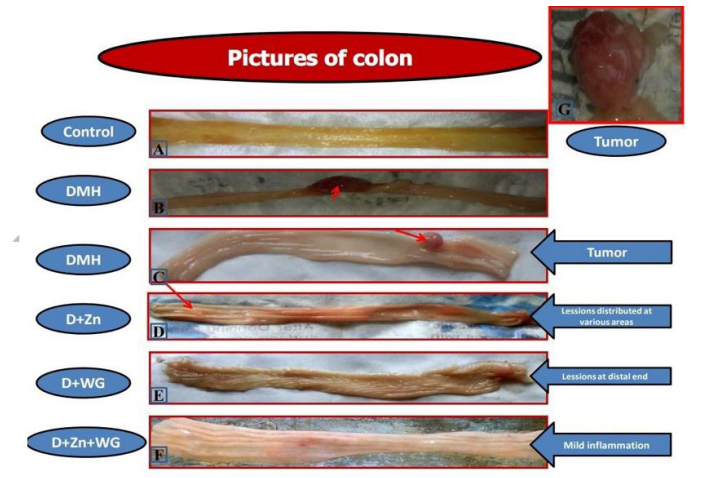 |
| Figure 1: Showing a macroscopic view of the colon of rats subjected to different treatments A: Normal colon from Group 1, B & C: Polypoidal tumour growth and severe inflammation in the longitudinally opened colon from Group2, D & E: Reddening of the surface with lesions distributed at various locations in the colon with some lesions at the distal end in zinc or wheatgrass treated groups, F: Only mild inflammation in colon treated with combined zinc and wheatgrass treated groups, G: Fully grown tumour. DMH: Dimethyl hydrazine, WG: Wheatgrass, Zn: Zinc |
Introduction
About a quarter of deaths in countries with a westernized lifestyle is caused by cancer, making it a significant problem that demands global attention. In developed countries, one of the prominent causes of cancer-related fatalities is colon cancer [1]. Colorectal cancer (CRC) is one of the commonest cancers with worldwide mortality of 850,000 deaths annually [2]. Factors playing an important role in the development of CRC include age, genetic and environmental factors [3]. CRC incidence rates vary greatly acrossAsia, with lowratesin all of SouthAsia and many high rates in other parts of Asia having more developed countries, such as Japan, Singapore, and South Korea [4]. A cascade of pathologic alterations transforms normal colonic epithelium into invasive carcinoma, resulting in colon cancer [5]. Dietary Inflammatory Index (DII) of food is low for nutrients rich in zinc, magnesium, selenium, vitaminslikeA, niacin, thiamin, riboflavin, vitamin B6, and B12. Physical inactivity increasesthe risk of colorectal cancer [3]. Diet and nutritional status play a key role in the etiology of CRC [6]. The intake of cereal grassesincluding wheatgrass, barley grass, and alfalfa is known to have a positive impact on health and vitality [7]. Chlorophyll, an active component in Wheatgrass extract, was found to inhibit the metabolic impact of carcinogens [8]. It also contains multiple vitamins (most having antioxidant properties), also high enzymatic activity of superoxide dismutase (SOD), cytochrome oxidase, etc [9]. Most people believe that using wheatgrass enhancesthe immune system, destroys harmful bacteria in the digestive system, and removestoxinsfrom the body [10]. It has been observed in various cell line-based experiments that wheatgrass had dose-dependent anticancer action [11].
In recent years, many macro and micronutrients have been found to have cancer preventive properties [12]. zinc is responsible for the alterations in membrane functions and biomarkers like TSA. Many experimental models of carcinogenesis have been used to search for and elucidate the molecular mechanisms involved in the multistage process of cancer development. 1,2-dimethylhydrazine (DMH), carcinogen affecting colon is used for the chemical induction of colon cancer. DMH induces descending colon tumors irrespective of the administration mode, and the histology matches the human sporadic colon tumors [13].
Although zinc is a widely explored micronutrient, the dietary benefits of wheatgrass remain unexplored. No work has yet been done to know the combined outcome of zinc & wheatgrass administration on preventing colon cancer. Therefore, the role of wheatgrass as an alternative therapy in colon cancer needs to be explored in the experimental model before it is recommended for clinical use.
Therefore, further studies are required to be carried out to assess the role of wheatgrass and zinc in CRC prevention. Moreover, there is ample scope for exploring the possible role of wheatgrass and zinc together being used as prophylaxis to delay initiation, development of colon tumors by addressing the biochemical indices which include ACF and TSA.
Materials and Methods
Study design - The study utilized male Sprague Dawley (SD) rats in the weight range of 220-270g, acclimatized for seven days before initiation of different treatments. They were kept in regular conditions in polypropylene cages. Analytical grade (AR) or laboratory-grade (LR) chemicals obtained from various pharmaceutical companies and research Laboratories. Wheatgrass was given in a dose of 100mg/kg body weight, which was found to provide maximum protection.
Setting The dose ofwheatgrasswas decided to be 100mg/kg body weight which provided maximum protection without causing any adverse effects. This dose was used for carrying out studies. The experimental setting was followed with a standardized dose of wheatgrass along with zinc.
Eight experimental groups each consisting of six male SD rats were given standard diets and divided in following 8 groups.
Group1 -This group served as control. The included rats were given standard diet and water ad libitum during the study.
Group 2-Animals in this group served as cancer group was given a DMH subcutaneous injection weekly in 1mM EDTA saline. The total duration of 16 weeks with 30mg/kg dose [14].
Group 3-Included animals were given an injection of DMH in 1mM EDTA saline weekly at a dose level of 30mg/kg body weight along with zinc as zinc sulfate at a dose of 227mg/l[15] in drinking water every day for 16 weeks. The zinc dose was started 15 days before the first injection of DMH.
Group 4- Rats were given DMH injections weekly as was given to group 2 animals. Wheatgrass tablets were given orally daily for a period of 16 weeks at a dose of 100mg/kg body weight (by dissolving wheatgrass tablets in drinking water). Wheatgrass dose was started 15 days prior to DMH injection.
Group 5- Rats were given weekly injections of DMH as was given to group 2 animals and zinc (227mg/l) along with wheatgrass daily for 16 weeks (100mg/kg body weight). Wheatgrass and zinc were started 15 days before the first dose of DMH was administered.
Group 6- Animals in this group were on zinc alone for 16 weeks in form of zinc sulfate (mixed in drinking water) daily at a dose as given to group 3 animals.
Group 7-Animals included were given wheatgrass in a dose given to group 4 animals till the duration of 16 weeks.
Group 8- Rats included were given wheatgrass tablets at a dose of 100mg/kg daily orally along with zinc (zinc sulfate) dissolved in water in a concentration of 227mg/l, daily for 16 weeks. Wheatgrass and zinc were started 15 days prior to the first injection of DMH.
Rats' food consumption and physical activity were tracked daily. Throughout the study, the body weight of animals was recorded in each group and was carefully maintained by weighing at the start of the experiment and then every week until the end of the study.
Methods of measurement
Preparation for Aberrant crypt foci counting:The whole colon of the designated animal was removed and washed with saline. Colon was cut, and subsequently overnight using buffered 10% formaldehyde as fixative. For identifying ACF the cut section of the colon staining was done for 3-5 minutes with 0.2% methylene blue. Counting of ACF was done using a light microscope (40X).
Biochemical Estimations: Determination of TSA, ACF were estimated using the standard method. To analyses the Histoarchitecture difference between control and treated rats, light microscopic studies were also done.
Statistical methods used: At 16 weeks, all parameters in the colons of SD male rats were examined for different treatments. The findings of various treatment groups were compared to the results of their respective controls. Analysis of variance was utilized for establishing the statistical significance of the values. The data were presented as a mean ± SD. A value of less than 0.05 P-value was deemed statistically significant.
Ethical guidelinesfollowed by the investigator:The animal care was done as per the guidelines of the animal ethics committee and according to National law on animal care and use. This study was approved by Institute Animal Ethics Committee vide ref no. 48/IAEC/230.
Results
Macroscopicviewoftumors: Figure1 (A) showsthemacroscopic view of the colon of control rats which did not reveal any inflammation and tumor. DMH treated rats depict the tumor in a longitudinally opened colon after 16 weeks. Polypoidal tumor growth is evident (B) and adjoining mucosa also shows signs of severe inflammation (C). Areas of reddening on the surface of the tumor represent superficial ulceration in the tumor (G). Figures 1 (D, E), show that zinc and wheatgrass supplementation leads to flat lesions in the colon. When a combined dose of zinc and wheatgrass was given, no tumor was observed but only mild inflammation in the mucosa (F). Thus, colon of normal (A) and combined zinc and wheatgrass treated animals did not show any tumor formation at 16 weeks.
Aberrant Crypt Foci Count: ACFs or precursor lesions are stereoscopically distinguishable by their darker staining, larger size, elliptical shape, and thicker epithelial lining as compared to normal crypts. The data for ACF counts /colon are summarized in table 1. DMH treated rats showed significantly decreased (P< 0.01) ACF counts /colon as compared to DMH treated rats on zinc and wheatgrass supplementation respectively. When zinc and wheatgrass were given together, they showed better results as the number of ACFs further reduced significantly (P< 0.001) as compared to the DMH group. No aberrant crypt foci were found in alone zinc and wheatgrass treated rats which showed that they have no toxic effect on the colon of rats.
Colon tumour analysis:In the present study tumour incidence was found to be 100% (N=6) after DMH treatment for 16 weeks. Administration of both zinc or wheatgrass has shown a decrease in the incidence of tumour formation is 66.6% (N= 4). The incidence rate further reduced to 33.3% (N=2) with synergistic ingestion of zinc + wheatgrass together. No tumour was found in zinc, wheatgrass, and zinc + wheatgrass together treated rats (Table 2).
Tumor multiplicity or the average number of tumors/rat was also studied. Tumor multiplicity was found to be 2.7 in rats treated with DMH only, which decreased to 2.0 and 1.8 in zinc and wheatgrass treated rats respectively. Combined ingestion of zinc and wheatgrass to DMH treated rats reduced tumor multiplicity to 0.9 (Table 2).
In addition, a significant (p< 0.001) increase in tumor size was observed in DMH treated rats. A significant (p< 0.01) reduction of tumor size was observed when zinc and wheatgrass were given separately along with DMH. Further, when zinc and wheatgrass were given in combination in group 5, tumor size reduced significantly (p< 0.001) Table 2.
It was observed that no tumor was present in groups when zinc and wheatgrass were given separately to normal rats which indicated that zinc and wheatgrass have no adverse effects.
Serum Total Sialic acid (TSA):In the current study, the serum levels of TSA of all groups are depicted in Table 3. Statistically significant (p< 0.01) increase in TSA levels at 8 weeks and 16 weeks following DMH treatment was observed. Zinc and wheatgrass supplementation for 8 weeks (separately and in combination) did not significantly change the TSA level as compared to DMH treated rats but the levels were significantly (p< 0.01) reduced at 16 weeks for zinc, and wheatgrass. It was also observed that a highly significant (p< 0.001) decrease was found with synergistic ingestion of zinc and wheatgrass at 16 weeks. Moreover, the animals administered with zinc and/or wheatgrass alone (without any carcinogen) demonstrated no change in the TSA levels after 8 and 16 weeks when compared with rats belonging to group 1 (Table 3).
Discussion
Thanikachalam et al. stated that pro-inflammatory foods components having low Dietary Inflammatory Index of food (DII) score like fiber, zinc, magnesium, selenium, vitamin A, fatty acids like omega 3, omega 6, several B complex vitamins, reduce the risk of CRC. They concluded that the dietary pattern, nutritional status, and physical activity determined the pathogenesis of colorectal cancer[3].
The present study was focused on the evaluation of the combined chemo preventive potential of phytonutrient wheatgrass and mineral zinc against 1, 2-dimethylhydrazine (DMH) induced colon carcinogenesis in rats. Rat colon carcinogenesis induced by DMH is one of the widely studied experimental model for various cancer chemoprevention trials [16-19] because of the above claims and facts, the present investigations were undertaken to explore the possible effects of synergistic supplementation of zinc and wheatgrass in the prevention of colorectal carcinogenesis. Therefore, the present study explored APC, TSA, Macroscopy parameters to investigate the efficacy of zinc and wheatgrass and their combined supplementation of zinc and wheatgrass in DMH-induced colon carcinogenesis.
A study on mouse embryonic fibroblast cells (NIH3T3-cells) found that wheatgrass had anticancer action on KB cells which was dose-dependent. It was also found to be non-toxic to cells. The cell inhibition of KB cells increases as the concentration of wheatgrass increases [11].
Tumor incidence and tumors multiplicity
In the present study, DMH administration to rats for 16 weeks resulted in 100% of tumors incidence and 2.75 tumors multiplicity in the colon of rats which is significantly higher as compared to control rats. The observed tumor incidence and multiplicity analysis in DMH treated rats confirmed the presence of carcinogenesis which could be due to alterations in various molecular, biophysical and biochemical indices. It was also shown that giving DMH to test animals boosted colon crypt proliferation and changed the location of proliferative and apoptotic cells in the colon during early carcinogenesis [19- 23]. It has also been shown in the literature that DMH-induced cancer in rat colon had colonic epithelium modification with dysplastic crypts. Whereas on giving multivitamins and mineral supplementation along with DMH there was restitution of the normal histology in colonic epithelial cells [24].
It was also observed in the present study that zinc and wheatgrass supplementation to DMH-treated rats showed an appreciable reduction in tumor incidence and multiplicity. Moderation achieved in tumor incidence and multiplicity following combined supplementation of zinc and wheatgrass was appreciably more, which is suggestive of enhanced efficacy of the combination in chemoprevention. The observed moderation in tumor incidence and multiplicity upon zinc and wheatgrass supplementation could be due to their ability to cause a decline in cancer cell proliferation by targeting various molecular indices. Apart from zinc, the possible action of wheatgrass has been explained in terms of the presence of abscisic acid (ABA). ABA has known anti-cancer properties even in small concentrations [25]. It has also been observed in the present study that 0% tumor incidences were found in alone wheatgrass and/or zinc treated groups which suggest that they do not cause any disruption in normal cellular homeostasis and hence are non-toxic.
A study done in-vitro experiments utilising HCT-15 cell lines also revealed that the aqueous wheatgrass extract had a mild anticancer activity. It has no cytotoxic potential in the Vero cell line, which was a normal cell line [26].
Aberrant crypt foci (ACFs) and Tumor analysis
Aberrant crypt foci are preneoplastic lesions detected in both laboratory animals and humans. Crypt multiplicity (number of crypts per focus) is a proven predictor of tumor development. It may offer an opportunity to observe the very early molecular alterations on the multistep pathway to colorectal cancer. In the present study, it was observed that DMH treatment produced colorectal tumor lesions in almost all treated rats. The presence of aberrant crypt foci in DMH-treated animals was also confirmed by various other studies (17,19,26,27). The number of ACF count/colon was 12±1.9 in the DMH group which is highly significant as compared to normal animals, i.e. 0. Zinc and wheatgrass supplementation caused decreased tumor incidence, lower multiplicity with the associated lessening of average tumor size thereby suggesting their potential role in inhibiting or slowing down tumorigenesis. Zinc and wheatgrass supplementation inhibited the formation of ACFs suggesting their role in suppression of pre neoplasia progression to frank malignant neoplasia [28].
Further, it has been reported that in vitro and in vivo experiments have proved chlorophyll, present in wheatgrass to demonstrate cancer-preventive biological activities including antioxidant activity, ant mutagenic activity, modulation of xenobiotic enzymes, and induction of apoptotic events [29].
Due to the above facts, it was observed that combined supplementation of zinc and wheatgrass showed a more pronounced effect as compared to when zinc and wheatgrass were given separately along with DMH treatment. This confirms the benefits of their synergistic supplementation.
Rucha Diwakar Gore et al. concluded that there was an inhibitory effect of aqueous extract of wheatgrass on Oral Squamous Cell Carcinoma (OSCC) cell line proliferation within 24 hours only [30].
Serum Total Sialic Acid levels, a laboratory marker for a variety of pathological conditions was used in this study [31].
The utility of serum glycol conjugates assays for early diagnosis of cancer and monitoring treatment progress have been studied in numerous studies [31,32].
In the present study, marked elevation in serum TSA concentrations has been noted after DMH treatment in rats for both durations of 8 and 16 weeks. Since sialic acid is a membrane component and during carcinogenesis increased cellular proliferation takes place. Therefore, its level is expected to increase during carcinogenesis as reported by other researchers [20,31]. The results suggest a benefit of using the TSA/TP ratio for the detection of colorectal cancer patients with less tumor burden (i.e. at an early stage). It was found to be more beneficial than CEA for monitoring patients with colorectal cancer [31].
On other hand, zinc and wheatgrass supplementation decreased the level of sialic acid at 8 and 16 weeks but was more significant at 16 weeks. This may be due to prolonged use of antioxidants like zinc and wheatgrass which regulate the glycoproteins level in the blood as well as tissue.
It was also observed that when zinc and wheatgrass were given in combination, they further bring down the levels of TSA due to their synergistic action but the difference was more significant at 16 weeks.
Conclusion
This study concludes that when a combined dose of zinc and wheatgrass was given, no tumor was observed in macroscopic view but only mild inflammation in the mucosa at the end of 16 weeks, and the number of ACFs reduced significantly and also bring down the levels of TSA due to their synergistic action. Thus, the role of wheatgrass and zinc as an alternative preventive therapy in colon cancer was observed in this study.
Conflict of Interest
There is no conflict of interest of any author.
Acknowledgments
Library support for plagiarism check and help of Sumit Jolan for typing the Manuscript is acknowledged.
Funding
This work was funded by Indian Council of Medical Research vide no 3/2/2/49/2
References
- Landis SH, Murray T, Bolden S, Wingo PA (1999) Cancer statistics, CA. A cancer Journal for Clinicians 49: 8-31.
- Biller LH, Schrag D (2021) Diagnosis and treatment of metastatic colorectal cancer: a review. Jama 325: 669-685.
- Thanikachalam K, Khan G (2019) Colorectal Cancer and Nutrition. Nutrients 11: 164.
- Cunningham D, Atkin W, Lenz HJ, Lynch HT, Minsky B, et al. (2010) Colorectal cancer. Lancet (London, England) 375: 1030- 1047.
- Millen AE, Subar AF, Graubard BI, Peters U, Hayes RB, et al. (2007) PLCO Cancer Screening Trial Project Team. Fruit and vegetable intake and prevalence of colorectal adenoma in a cancer screening trial. Am J Clin Nutr 86: 1754-1764.
- Yusof AS, Isa ZM Shah SA (2012) Dietary patterns and risk of colorectal cancer: a systematic review of cohort studies (2000- 2011). Asian Pac J Cancer Prev 13: 4713-4717.
- González CA, Pera G, Agudo A, Bueno-de-Mesquita HB, Ceroti M (2006) Fruit and vegetable intake and the risk of stomach and oesophagus adenocarcinoma in the European Prospective Investigation into Cancer and Nutrition (EPICEURGAST). Int J Cancer 118: 2559-2566.
- Manju V and Nalini N (2005) Chemopreventive potential of luteolin during colon carcinogenesis induced by 1,2-dimethylhydrazine. Ital J Biochem. 54: 268-275.
- Rana SV, Kamboj JK and Gandhi V (2011) Living life the natural way – Wheatgrass and Health. Functional Foods in Health and Disease 1: 444-456.
- Wheat J and Currie G: Herbal medicine for cancer patients: An evidence-based review. Internet Journal of Alternative Medicine 5: 1-20.
- Hattarki SA, Bogar C and Bhat K (2020) Triticum aestivum (wheat grass) Exhibited Anticancer Activity on Oral Cancer (KB) Cell Line. Int J Pharma Res Health Sci 8: 3220-224.
- Ho E (2004) Zinc deficiency, DNA damage and cancer risk. The Journal of nutritional biochemistry.15: 572-578.
- Christudoss P, Selvakumar R, Pulimood AB, Fleming JJ and Mathew G (2012) Zinc and zinc related enzymes in precancerous and cancerous tissue in the colon of dimethylhydrazine treated rats. Asian Pacific Journal of cancer prevention 13: 487-492.
- Soler AP, Miller RD, Laughlin KV, Carp NZ, Klurfeld DM, et al. Increased tight junctional permeability is associated with the development of colon cancer. Carcinogenesis 20: 1425-1432.
- Goel A, Dani V and Dhawan DK (2005) Protective effects of zinc on lipid peroxidation, antioxidant enzymes, and hepatic histoarchitecture in chlorpyrifos-induced toxicity. Chem Biol Interact 156: 131-140.
- Ghadi FE, Malhotra A, Ghara AR and Dhawan DK (2012) Selenium as a modulator of membrane stability parameters and surface changes during the initiation phase of 1, 2-dimethylhydrazine induced colorectal carcinogenesis. Molecular and cellular biochemistry 369: 119-126.
- Hamiza OO, Rehman MU, Khan R, Tahir M, Khan AQ, et al. (2014) Chemopreventive effects of aloin against 1, 2-dimethylhydrazine-induced preneoplastic lesions in the colon of Wistar rats. Human & experimental toxicology. 33: 148-163.
- Saini MK, Vaiphei K and Sanyal SN (2012) Chemoprevention of DMH-induced rat colon carcinoma initiation by combination administration of piroxicam and C-phycocyanin. Molecular and cellular biochemistry 361: 217-228.
- Perše M and Cerar A (2005) The dimethylhydrazine induced colorectal tumours in rat-experimental colorectal carcinogenesis. Radiology and Oncology. 39: 61-70.
- Vinothkumar R, Vinothkumar R, Sudha M and Nalini N (2014) Chemopreventive effect of zingerone against colon carcinogenesis induced by 1, 2-dimethylhydrazine in rats. European journal of cancer prevention 23: 361-371.
- Visca P, Alò PL, Del Nonno F, Botti C, Trombetta G et al. (1999) Immunohistochemical expression of fatty acid synthase, apoptotic-regulating genes, proliferating factors, and ras protein product in colorectal adenomas, carcinomas, and adjacent nonneoplastic mucosa. Clinical Cancer Research 5: 4111-4118.
- Hamiza OO, Rehman MU, Tahir M, Khan R, Khan AQ, et al. (2012) Amelioration of 1, 2 Dimethyl hydrazine (DMH) induced colon oxidative stress, inflammation and tumor promotion response by tannic acid in Wistar rats. Asian Pac J Cancer Prev. 13: 4393-4402.
- Barnes CJ, Hardman WE and Cameron IL (1999) The presence of well-differentiated distal, but not poorly differentiated proximal, rat colon carcinomas is correlated with increased cell proliferation in and lengthening of colon crypts. Int J Cancer 80: 68-71.
- Arul AB, Savarimuthu I, Alsaif MA, Al Numair KS (2012) Multivitamin and mineral supplementation in 1, 2-dimethylhydrazine induced experimental colon carcinogenesis and evaluation of free radical status, antioxidant potential, and incidence of ACF. Can J Physiol Pharmacol 90: 45-54.
- Gloria G (2019) The Science Behind Wheatgrass Juice and Health.
- Patel JB, Patel P, Parmar RS, Patel P, Patel D (2019) Anticancer and Cytotoxic Potential of Aqueous Extract of Triticum aestivum on Colorectal Carcinoma. Journal of Drug Delivery and Therapeutics 9: 164-169.
- Fuku N, Ochiai M, Terada S, Fujimoto E, Nakagama H, et al. (2007) Effect of running training on DMH-induced aberrant crypt foci in rat colon. Med Sci Sports Exerc 39: 70-74.
- Fontana MG, Ghirardi M, Moneghini D, La Pinta M, Villanacci V, et al. (2001) Distribution of 1, 2 DMH-induced colonic aberrant crypt foci after administration of a gastrin receptor antagonist (CR2945), in the murine model. Annali Italiani di Chirurgia 72: 221-225.
- Dani V, Goel A, Vaiphei K, Dhawan DK (2007) Chemopreventive potential of zinc in experimentally induced colon carcinogenesis. Toxicol Lett 171: 10-18.
- Egner PA, Munoz A and Kensler TW (2003) Chemoprevention with chlorophyll in individuals exposed to dietary aflatoxin. Mutat Res 523: 209-216.
- Gore RD, Palaskar SJ and Bartake AR (2017) Wheatgrass: Green Blood Can Help to Fight Cancer. J Clin Diagn Res 11: ZC40-ZC42.
- Miyazaki K, Ohmori K, Izawa M, Koike T, Kumamoto K, Furukawa K, Ando T, Kiso M, Yamaji T, Hashimoto Y, Suzuki A, Yoshida A, Takeuchi M and Kannagi R (2004) Loss of sialyl Lewis(a), the ligand for lymphocyte inhibitory receptor sialic acid-binding immunoglobulin-like lectin- 7 (Siglec-7) associated with increased sialyl Lewis(a) expression on human colon cancers. Cancer Res 64: 4498-4505.
- López-Morales D, Reyes-Leyva J, Santos-López G, Zenteno E, Vallejo-Ruiz V (2010) Increased expression of sialic acid in cervical biopsies with squamous intraepithelial lesions. DiagnPathol. 74: 1-5.
- Gruszewska E, Chrostek L, Cylwik B, Tobolczyk J, Szmitkowski M, et al. (2013) Serum sialic acid as a marker of pancreatic cancers. Clin Lab. 59: 781-788.
Artcle Information
Review Article
Received Date: June 29, 2022
Accepted Date: August 10, 2022
Published Date: August 12, 2022
American Journal of Cancer Research and Oncology
Volume 1 | Issue 1
Citation
Jaspreet Sharma, Manisha Naithani, Saloni Malik, Kaushal Kishor Prasad, Devinder Kumar Dhawan and Satya Vati Rana (2022) Prevention of Colon Cancer with Wheatgrass and Zinc in Rats. Am J Cancer Res Oncol 1: 1-13
Copyright
©2022 Satya Vati Rana. This is an open-access article distributed under the terms of the Creative Commons Attribution License, which permits unrestricted use, distribution, and reproduction in any medium, provided the original author and source are credited.

doi: ajco.2022.1.103