


Review Article
Volume-1 Issue-1, 2021
Evaluation of growth performance and slaughter traits of Aseel chicken grown with and without outdoor access
Received Date: April 28, 2021
Accepted Date: May 17, 2022
Published Date: May 18, 2022
Journal Information
Abstract
A study was conducted to investigate the effects of freerange, part-time free range, and confinement rearing systems on performance of the four Aseel chicken varieties (Lakha, Mushki, Peshawari, and Sindhi) for 10-week duration (7-16 week). A total, 216 Aseel cockerels (6-wk-old), 54 from each of the variety, were allotted to 12 experimental groups, in a 3 × 4 (rearing system × Aseel variety) factorial arrangement under a randomized complete block design, replicated 3 times with 6 birds in each. Final body weight, weight gain, folds of increase, and mortality parameters of the growth performance and carcass, breast, thigh, drumstick, wing, liver, gizzard, and heart yields parameters of the slaughter traits were evaluated. Data were analyzed by using the 2-way ANOVA under factorial arrangement. The results indicated increased body weight gain, folds of increase, breast and drumstick in both confinement and part-time free range (p < 0.05), whereas enhanced body weight, dressing, thigh, liver, and gizzard only in confinement rearing system. Among the Aseel varieties, Sindhi showed enhanced final body weight, weight gain, thigh and drumstick yields, whereas breast and gizzard weights were found to be greater in Lakha and Sindhi varieties. Carcass yield, however, remained higher in all varieties except Peshawari. These results suggest that indoor rearing system has a positive effect on the growth and slaughter traits of Aseel chicken. Among the varieties, Sindhi showed better growth and slaughter performance in alternative rearing systems and hence, can be used as slower growing meat chicken in outdoor system of poultry production in developing countries for better livelihood.
Key words
Aseel, growth performance, outdoor access,slaughter trait
Ingredient (%) |
Value |
Corn |
62.11 |
Soybean meal (48% CP) |
31.05 |
Soybean oil |
3.01 |
Sodium chloride |
0.33 |
Dicalcium phosphate |
1.74 |
Limestone, pulverized |
1.31 |
Supplement1 |
0.30 |
DL-Methionine |
0.15 |
Total |
100.00 |
Nutrient composition (calculated) |
|
ME, kcal/kg |
3,050 |
CP% |
20.00 |
Calcium% |
2.81 |
Phosphorus% |
0.93 |
Lysine% |
1.09 |
Methionine% |
0.45 |
Effects2 |
|
Parameters1 |
|
|
BW (g) |
WG (g) |
FI (g) |
M (%) |
|
Rearing system3 |
(n=72) |
|||
FR |
1371.83±19.09c |
844.96±18.98b |
2.60±0.04b |
4.16 |
PFR |
1456.00±17.37b |
953.50±18.54a |
2.93±0.05a |
0 |
CF |
1507.29±23.88a |
997.92±28.75a |
3.09±0.08a |
0 |
Aseel variety4 |
(n=54) |
|||
L |
1455.28±29.62b |
933.89±31.59b |
2.80±0.07 |
1.85 |
M |
1437.78±25.48b |
933.61±29.57b |
2.88±0.09 |
0 |
P |
1374.22±18.44c |
852.83±23.08c |
2.94±0.08 |
0 |
S |
1512.89±22.87a |
1008.17±24.83a |
2.89±0.09 |
3.70 |
Category |
p-value |
|||
Rearing system |
<0.001 |
<0.001 |
<0.001 |
- |
Aseel variety |
<0.001 |
0.001 |
NS5 |
- |
Rearing system × Aseel |
NS |
NS |
NS |
- |
1BW=body weight; WG=weight gain; FI=fold of increase; M=mortality.
2 FR=free-range; PFR=part-time free range; CF=confinement; L=Lakha; M=Mushki; P=Peshawari; S=Sindhi.
3 Each value represents the mean of 12 replicates of 6 birds each.
4 Each value represents the mean of 9 replicates of 6 birds each.
5 NS=not significant (p > 0.05).
6 Interaction of rearing systems and Aseel variety comprised 12 experimental groups (n=18).
Parameters3 |
Effects1,2 (n=24) |
P – value |
||
FR |
PFR |
CF |
||
CY (%) |
61.37±0.25c |
62.62±0.35b |
65.49±0.26a |
<0.001 |
BR (%) |
24.81±0.23a |
22.88±0.28b |
22.64±0.22b |
<0.001 |
TH (%) |
16.39±0.18c |
17.73±0.17b |
19.18±0.21a |
<0.001 |
DS (%) |
14.43±0.20b |
15.06±0.37b |
17.77±0.28a |
<0.001 |
W (%) |
11.87±0.22 |
12.37±0.18 |
12.16±0.19 |
NS4 |
L (%) |
2.13±0.06c |
2.38±0.04b |
2.75±0.08a |
<0.001 |
G (%) |
2.65±0.05c |
2.88±0.06b |
3.09±0.06a |
<0.001 |
H (%) |
0.71±0.01 |
0.71±0.01 |
0.71±0.01 |
NS |
1 FR=free range; PFR =part-time free range; CF=confinement.
2 Each value represents the mean of 12 replicates of 2 birds each.
3 CY=carcass yield; BR=breast; TH=thigh; DS=drum-stick; W=wing; L=liver; G=gizzard; H=heart.
4 NS=not significant (p > 0.05).
Parameters3 |
Effects1,2 |
P-value |
||||
L |
M |
P |
S |
AV |
RS × AV |
|
CY (%) |
63.28±0.47a |
63.34±0.56a |
62.15±0.52b |
63.86±0.53a |
0.004 |
NS |
BR (%) |
23.95±0.33a |
23.45±0.37a,b |
22.71±0.30b |
23.67±0.39a |
0.013 |
NS |
TH (%) |
17.92±0.40a,b |
17.47±0.37b |
17.35±0.27b |
18.34±0.31a |
0.002 |
0.045 |
DS (%) |
15.64±0.55a,b |
15.79±0.45a,b |
15.14±0.51b |
16.44±0.38a |
0.027 |
0.004 |
W (%) |
12.22±0.24 |
12.01±0.29 |
11.76±0.21 |
12.54±0.14 |
NS4 |
NS |
L (%) |
2.57±0.09a |
2.30±0.08b |
2.35±0.09b |
2.47±0.10a,b |
0.037 |
NS |
G (%) |
3.00±0.08a |
2.79±0.07b |
2.73±0.06b |
2.98±0.08a |
0.003 |
NS |
H (%) |
0.70±0.01 |
0.71±0.01 |
0.71±0.01 |
0.73±0.01 |
NS |
0.020 |
1 L=Lakha; M=Mushki; P=Peshawari; S=Sindhi.
2 Each value in table represents the mean of 9 replicates of 2 birds each.
3 CY=carcass yield; BR=breast; TH=thigh; DS=drum-stick; W=wing; L=liver; G=gizzard; H=heart.
4 NS=not significant (p > 0.05).
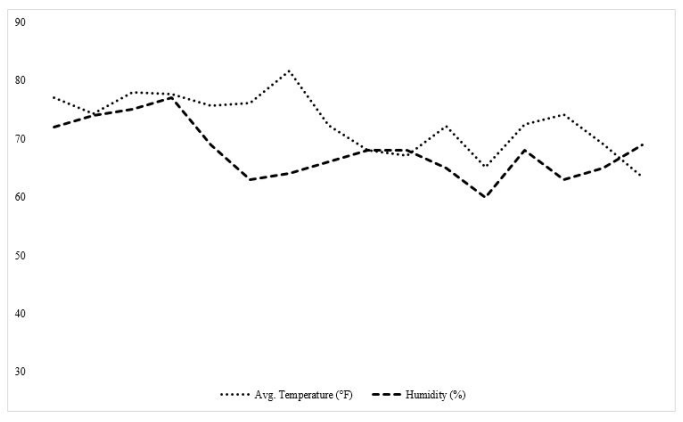 |
| Figure 1: Variations in temperature (oF) and humidity (%) by a wet and dry bulb hygrometer (Mason’s type, Zeal, England) |
Introduction
In recent days, alternative rearing systems are becoming attractive due to limited use of chemical additives, synthetic fertilizers and antibiotics [1]. Natural environment in free-range provides fresh vegetation and grasses to the birds Glatz, et al. [2] and their droppings act as organic fertilizers, enhancing soil fertility yielding greater beans and crops [3]. High quality forages like grasses, legumes and clover improve nutrient intake in birds [4]. Birds in free range disperse in small groups, having complete freedom of expressing their natural behavior [5, 6, 7]. Similarly, part-time free range rearing system improves behavioral activities as well as their performance of the birds [8]. Variable pasture intake in free range system, however, may adversely affect weight gain and feed efficiency in chicken [9]. Pasture management plays a crucial role in making free range healthier and more welfare friendly for the growing flocks [10].
In Pakistan, poultry farming has developed from a small scale family operation to a large scale, big business operation, resulting in closure of traditional open-sided poultry houses [11]. This alarming situation urges poultry geneticists to explore such chicken breeds, which would be suitable for natural meat production in open environment, reviving the prestigious agrobased poultry culture and rehabilitation of livelihood in rural households [11, 12]. Slow-growing chicken, being scavenging in nature, has an ability to survive on insufficient feed resources under traditional free range conditions [13]. Indigenous chicken is reared mainly by small poultry farmers within limited resources, generating income for their households [14]. Aseel chicken is a well-known indigenous breed of Indo-Pak subcontinent; popular for its better adaptability, hardiness, and low mortality in sub-tropical region like Pakistan [15].
Mainly 16 Aseel varieties are inhabitant to Pakistan (M. S. Khan, Univ. Agric. Faisalabad: personal communication), out of which, Lakha is characterized by reddish-brown plumage with black or white mottling, Mushki has a black plumage with black pigmentation in beak and shanks, Peshawari has a wheaten-colored plumage Babar, et al. [16] and Sindhi possesses a reddish-brown plumage with hard and short feathers [17]. On the basis of robustness, disease resistance, better adaptability to the inclement climatic conditions, and excellent meat producing qualities, Aseel may be used for meat production in alternative rearing systems and help in the revival of small-scale rural poultry farming in open-sided houses. A lot of work has been done in India using Aseel chicken in the farm as well as in field conditions, however, no specific work has, so for, been conducted to investigate the performance of Aseel chicken under free-range, part-time free range, and confinement rearing systems. The present study was planned to evaluate the growth and slaughter performance in 4 varieties of Aseel chicken (Lakha, Mushki, Peshawari, and Sindhi) under free-range, part-time free range, and confinement rearing systems.
Materials and methods
Ethical approval
The care and use of birds and all experimental protocols were in accordance with the laws and regulations of Pakistan which were approved by Institutional Review Committee for Biomedical Research University of Veterinary and Animal Sciences, LahorePakistan via letter no. DR/910.
Experimental Station, Birds and Rearing Systems
The present study was conducted at Indigenous Chicken Genetic Resource Centre (ICGRC), Department of Poultry Production, Ravi Campus (located at 31° 10’ North and 73° 51’ East longitudes) University of Veterinary and Animal Sciences (UVAS), Lahore, for 10 week duration (7-16 weeks). The summers are sweltering, humid and clear whereas the winters are short, cool and dry. Long-term average annual temperature at Pattoki varies from 28 °C to 40 °C. Average annual relative humidity ranges between 40 and 75%.
In total, 216 Aseel cockerels, 54 from each of the variety were randomly assigned to 12 experimental groups, in a 3 × 4 (rearing system × Aseel variety) factorial arrangement under a randomized complete block design. Each experimental group was replicated 3 times with 6 birds in each replicate. All birds in each variety were weighed before the start of the experiment and they were uniform in body weight. Experimental birds were maintained in an independent open-sided poultry house, measuring 6.1 × 6.1 m (37.21 m2) with East to West dimension, opening towards North in free range. The house was equipped with a 3-tiered growing cage, measuring 1.52 × 4.57 m (20.84m2, 6.91 birds/m2), with removable dropping trays and automatic nipple drinking system. Trough feeders were available for feeding of the birds. Free-range area (specified for free range and parttime free range; stocking density, 0.27 birds/m2) was surrounded by a 2.44 m high enclosure to avoid the entry of predators. Seasonal legumes (cereals, beans, cowpeas, lentils, and grasses) and non-legumes were cultivated in free range. Replication in free range was done with the help of fish-net and fresh water in each replicate was available through nipple drinking system.
Birds under confinement rearing system remained 24 h in cages with 100% allowance (0800 h) of corn-soybean based broiler grower ration (Table 1). The ration used was iso-nitrogenous and iso-caloric (20.00% CP, 3,050 kcal/kg ME). The birds under part-time free range system had access to free range from 0800 to 1200 h. Subsequently, they were maintained in cages from 1200 to 0800 h and offered 50% of feed allowance at 1700 h. However, birds under the free range system had free access to free range area from 0800 to 1600 h. Thereafter, they were shifted to the house and maintained on floor from 1600 to 0800 h (stocking density, 2.38 birds/m2), with rice husk used as bedding material (15 cm) and offered 25% feed allowance (1700 h). Natural light and similar prophylaxis and hygienic measures were adopted in all rearing systems. The experimental birds were vaccinated against Newcastle disease (ND), infectious bronchitis (IB), and infectious bursal disease (IBD), following the recommendations of vaccine manufacturing company under the supervision of a qualified veterinarian. Throughout the trial, temperature and RH remained in the range of 13 to 30o and 52 to 67% , respectively. Such variations in daily temperature and humidity (%) were noted using a wet and dry bulb hygrometer (Mason’s type, Zeal, England) and later an average of the temperature and humidity were derived on weekly basis as shown in Figure 1.
Data Collection
Initial and final body weights were recorded by using electronic balance (accuracy of 0.01 g) (WANT ® Wt-G) to calculate the body weight gain and folds of increase. Daily mortality, if any, was recorded to calculate the percentage of mortality. At 16 week of age, a total of 72 birds, 2 from each replicate with average body weight, were picked and tagged according to variety and rearing system. They were kept off-feed for 4 hours before slaughtering. Birds were weighed and slaughtered manually according to the Halal method of slaughtering, allowed to bleed for 3-4 minutes, and feather plucking was done after scalding the carcass at 50-60oc for 1-1.5 minutes [18]. Carcass yield was taken as weight of hot eviscerated carcass without skin after removing shanks, head, feathers, and abdominal fat (except the lungs and kidneys) in relation to the live weight multiplied by 100 [19]. Percentages of breast, thigh, drumstick and wing were calculated as their individual weight relative to the dressed weight multiplied by 100, whereas liver, gizzard, and heart percentages were calculated as in relation to the live weight multiplied by 100.
Statistical Analysis
The data were analyzed by using the 2-way ANOVA under factorial arrangement applying the GLM procedure of SAS version 9.1 [20]. Variety and rearing system were considered as main effects and their interaction was also tested. Means among treatments were compared through Duncan’s Multiple Range test at 5 % probability level [21].
The statistical model used was:
Where, Yijk = Observed dependent variable; μ = Overall mean; Ri = Effect of rearing system; Vj = Effect of Aseel variety; (R×V)ij = Interaction in rearing system and Aseel variety; and εijk =Residual error.
Results
Free range rearing can directly and indirectly affect health, welfare, productivity and quality of local chickens in terms of their growth performance and carcass yield [6, 22]. Consumer interest for poultry products derived from free range systems is on rising trend [5, 6, 7].
Growth performance in broilers
Growth performance indicators are often used to assess poultry production [23]. Previous studies have indicated that poultry growth performance indicators are affected by rearing systems [7, 24].
In the present study, final body weight was significantly affected (p < 0.05) by the rearing systems and the Aseel varieties. Birds reared indoor achieved the highest (p < 0.05) body weight (Table 2) followed by those in part-time free range and free range. This can be attributed to the availability of balanced diet and absence of activities like walking, running and jumping in confinement. Birds reared indoor and part-time free range showed increased (p < 0.05) weight gain compared with those in free range that could be attributed to the greater (p < 0.05) body weight (Table 2) of the indoor reared birds.
Slaughter traits of broilers
Carcass yield is an important trait for poultry production that may affect both consumers’ purchase intention and poultry production profits [6, 23]. In the present study, carcass yield increased (p < 0.05) in confinement rearing system (Table 3) followed by part-time free range and free range that could be attributed to larger body weight of the birds in confinement. Among the varieties, Sindhi, Mushki, and Lakha showed greater (p < 0.05) carcass yield than Peshawari (Table 4). Literature shows that carcass yield depends largely on live weight of the birds Moujahed and Haddad, [40] hence; increased carcass yield in Sindhi, Mushki, and Lakha may be attributed to their higher body weights (Table 2).
Discussion
In line with these results, Pavlovski, et al. [25] who reported that the chickens reared indoor were significantly heavier than freerange chickens. According to Ward, et al. [26] the 40-days old broiler-reared Ross pullets achieved considerably higher body weight compared to free-range birds at the same age. Ponte, et al. [27]; Dou, et al. [28] likewise, observed increased body weight in birds reared indoor, indicating that intensive system of poultry production is better in term of body growth of the birds [29, 30, 31]. Higher body weight in indoor reared birds than those of free-range was also reported [32]. Wang, et al. [9] who reported that slow-growing Gushi chickens reared indoors to day 112 of age achieved significantly higher body weight compared to freerange chickens. Similarly, Ahmad, et al. [33] who concluded that birds under intensive and semi-intensive systems were significantly heavier at slaughter than free range birds. Lower body weight of free range birds in the present study can be attributed to greater energy expenditure by the birds. Ricke, et al. [34] who indicated that great physical activity and the large energy expenditure associated with the thermoregulation of organic birds can influence their production properties. A study by Jin, et al. [35] who reported that body weight of birds decreased significantly (p < 0.05) in the first 2 week after birds were assigned to free-range treatment compared with those in the conventional treatment. Among the varieties, Sindhi showed the highest (p < 0.05) final body weight followed by Lakha, Mushki and then Peshawari. Poultry Genetic has a major share in body weight Batkowska, et al. [36] therefore, difference in final body weight among the varieties may be attributed to the differences in their genetic make-up.
Similar to these findings, Dou, et al. [28] who observed an increased weight gain in indoor rearing system than free-range, indicating that indoor system of poultry production is better than free-range in term of weight gain [9]. More locomotor activity and less rest could be the reasons for poorer growth rate of birds in free-range. Jin, et al. [35] who reported that average daily gain decreased significantly (p < 0.05) for chickens assigned to freerange treatment from 56 to 70 D of age. Similarly, Li, et al. [37] who reported that the body weight gain of free-range broilers were lower than in those kept in cage and indoor-range systems. The negative effect of the organic rearing system of chickens on body weight gain was also reported for Ross cockerels aged 56 and 81 days [38]. Among the varieties, Sindhi showed the highest (p < 0.05) weight gain followed by Lakha, Mushki and then Peshawari. According to reports Santos, et al. [30] who reported that patterns of growth depend largely on inherent ability of the birds for growth; hence, increased gain in Sindhi may be attributed to its better genetic potential.
In the present study, folds of increase was found to be greater in confinement and part-time free range than free range. This may be attributed to the balanced diet and relatively better management of the birds in confinement. Similarly, Dou, et al. [28] who reported higher folds of increase in birds reared indoor than free range, supporting the argument that indoor rearing system regarding growth is better than the other rearing systems [14]. Aseel varieties independently and in interaction with rearing systems did not affect (P = 0.584) folds of increase. Mortality percentage was found to be lower in indoor followed by part-time free range and free range. Balanced diet, better management and relatively improved biosecurity in confinement rearing system are assumed to have caused reduction in mortality. Similar to these findings, reduced mortality in indoor system of poultry production compared to free-range has previously been reported [32]. According to Baeza, et al. [39] who reported that free-range access caused increased mortality. Varieties independently and in interaction with the rearing systems did not influence (p > 0.05) mortality percentage. Similarly, Skomorucha, et al. [31] who reported an increased carcass yield in an indoor rearing system than outdoor. Ahmad, et al. [33] likewise, reported a positive effect of outdoor access on the carcass yield. Fanatico, et al. [41] who also indicated direct association of dressing percentage with final body weight of the birds.
In the present study, breast yield increased (p < 0.05) in free range than part-time free range and confinement rearing systems. It is quite possible that more physical exercise and locomotor activity in free range might have promoted breast muscle accretion. Similarly, Tong, et al. [6] who reported an increased breast yield in birds reared outdoor than indoor, indicating that outdoor system of poultry production is better in term of breast yield [33]. Jin, et al. [35] likewise, reported that breast yield of the birds increased linearly with increasing free-range days (p < 0.05). Castellini, et al. [38] similarly, observed that birds having freerange access were characterized by a higher percentage of breast muscles in the carcass. Skomorucha, et al. [31] however, reported that the birds reared indoors achieved higher breast muscle yield compared to the birds grown with outdoor access. Similarly, no significant effect (p > 0.05) of free range on the breast yield has also been reported in literature [9]. Among the Aseel varieties, birds of Lakha and Sindhi showed greater (p < 0.05) breast yield than those of the Peshawari. This may be attributed to the high breast weight and carcass weight ratio (BW/CW) in Lakha and higher final body weight and weight gain in Sindhi. There are reports that different strains Mikulski, et al. [4] or breeds Musa, et al. [42] behave differently in breast weight.
Thigh yield was found to be greater (p < 0.05) in confinement followed by part-time free range and free range. Birds assigned to confinement rearing system had larger body weight and weight gain than those under part-time free range and free range, which might have contributed to thigh yield. In line with these results, Ahmad, et al. [33] who observed that birds reared indoor had higher thigh yield than semi-intensive and free-range birds. Poltovics and Doktor [32] likewise, reported greater thigh weight in indoor rearing system than the free-range, concluding that thigh yield varies due to rearing systems [14]. The positive effect of free-range on thigh yield was also reported by [38]. Among the varieties, Sindhi showed higher (p < 0.05) value of thigh yield than Mushki and Peshawari. Higher value of thigh yield in Sindhi may be a result of higher body weight and weight gain of the Sindhi birds. According to reports Mikulski, et al. [4] thigh yield has a close association with genotype of the bird.
Birds reared indoor showed higher (p < 0.05) drumstick yield compared with part-time free range and free range. This may be related to less exercise and minimum activity of birds in confinement rearing system. Similar to these findings, Ahmad,et al. [33] who found that birds reared indoor achieved higher drumstick weight compared to free-range and part-time freerange. Inci, et al. [43] likewise, observed variations in drumstick weight of quails under different rearing systems. Among the varieties, Sindhi showed increased (p < 0.05) drumstick yield than the Peshawari. This may be attributed to the higher body weight of Sindhi. Significant effect of different genotypes Musa, et al. [42] or breeds Mikulski, et al. [4] on drumstick weight has already been reported in literature. Rearing systems (P = 0.189), Aseel varieties (P = 0.098), and their interaction (P = 0.216) did not influence wing percentage. Similar reports were presented by Faria, et al. [44] who compared different strains of birds, indicating that different breeds Choo, et al. [45]; Hrncar, et al. [46] or genotypes Batkowska, et al. [36] had no effect on wing percentage. No significant effect of different rearing systems on wing weight has also been reported in literature [6]. Like a study by Wang, et al. [9] who showed no significant differences in the percentage of wing muscles between chickens reared in freerange and conventional systems. However, Ahmad, et al. [33] who found higher wing weight in intensive birds compared to semi-intensive and free-range birds.
Value of the liver percentage was found to be highest (p < 0.05) in birds reared indoor followed by those in part-time free range and free range, which can be attributed to the fact that lack of exercise (with fewer nutrients being expended for energy) and high energy diet stimulated hepatic lipogenesis. In line with these results, Bughio, et al. [47] who reported that intensively reared birds had higher liver weight compared to free-range birds. Similarly, Zhao, et al. [48] who reported heavier livers in chickens raised in cages than those reared on the floor. Ahmad, et al. [33] however, found that liver weight increased in semiintensive birds as compared to free-range and intensive systems. Similarly, Abdullah and Buchtova [49] who observed that the livers of organically raised chicken broilers were heavier than those of conventionally bred birds. Among the varieties, Lakha demonstrated increased (p < 0.05) liver weight compared with the Peshawari and Mushki. Reasons for increased liver weight in Lakha compared to Peshawari and Mushki could not be readily ascertained. According to Musa, et al. [42] who observed that liver weight varies from strain to strain Santos, et al. [30] variety to variety Jatoi, et al. [50] and breed to breed [51].
In the present study, value of gizzard weight was observed to be the highest (p < 0.05) in birds reared indoor followed by those in part-time free range and free range. Similarly, Santos et al. [30], who also observed a significant effect of rearing system on gizzard weight [33]. Inci, et al. [43] however, reported that there is no effect of rearing system on gizzard weight. Among the varieties, birds of Lakha and Sindhi exhibited higher (p < 0.05) gizzard weight than those of the Mushki and Peshawari. Ojedapo, et al. [51] who also observed significant breed or genotype effect on gizzard weight. Jatoi, et al. [50] however, presented the facts other way round, reporting no significant effect of genotype on gizzard weight, which was further corroborated by the findings of [36]. Rearing systems (P = 0.998) as well as Aseel varieties (P = 0.408) did not influence heart weight. Likewise, it was reported that different Aseel varieties Jatoi, et al. [50] as well as genetic groups of poultry Batkowska et al. [36] who showed no effect on heart weight. As mentioned above, rearing systems did not influence heart weight. These findings are in agreement with those of Inci, et al. [43], whose study showed no significant effect of rearing systems on heart weight.
Conclusion
Based on the current findings, it can be concluded that confinement rearing system had positive effects on growth and slaughter performance of indigenous Aseel chicken. Among the Aseel varieties, Sindhi showed better growth performance in alternative systems of production. Hence, Sindhi variety could be used as slower growing meat-type chicken in alternative rearing system, reviving agro-based rural poultry activity, bringing small poultry farmers into business.
Acknowledgements
The authors gratefully acknowledge the Department of Poultry Production, University of Veterinary and Animal Sciences, Lahore for supporting the trial.
Funding
Not applicable
Competing Interests
No potential conflict of interest was found by the authors.
Author, s contributions
Muhammad TK designed and carried out the experiment, analyzed the data, and interpreted the results. Fazal R & Muhammad SR conducted laboratory work and revised the manuscript.
References
- Castellini C, Berri C, Bihan-Duval LE, Martino G (2008) Qualitative attributes and consumer perception of organic and free range poultry meat. Worlds Poult Sci J 64: 500-12.
- Glatz PC, Ru YJ, Miao ZH, Wyatt SK, Rodda BJ, et al. (2005) Integrating poultry into a crop and pasture farming system. Int J Poult Sci 4: 187-91.
- Hilimire K, Gliessman SR, Muramoto J (2012) Soil fertility and crop growth under poultry/crop integration. Ren Agr Food Sys 28:173-82.
- Mikulski D, Celej J, Jankowski J, Majewska T, Mikulska M, et al. (2011) Growth performance, carcass traits and meat quality of slower-growing and fast-growing chickens raised with and without outdoor access. Asian-Austral J Anim Sci 24: 1407- 16.
- Chen X, Jiang W, Tan HZ, Xu GF, Zhang XB, et al. (2013) Effects of outdoor access on growth performance, carcass composition, and meat characteristics of broiler chickens. Poult Sci 92: 435-43.
- Tong HB, Wang Q, Lu J, Zou JM, Chang LL, et al. (2014) Effect of free-range days on a local chicken breed: Growth performance, carcass yield, meat quality, and lymphoid organ index. Poult Sci 93: 1883-9.
- Wang Y, Ru YJ, Liu GH, Chang WH, Zhang S, et al. (2015) Effects of different rearing systems on growth performance, nutrients digestibility, digestive organ weight, carcass traits, and energy utilization in male broiler chickens. Lives Sci 176: 135-40.
- Barbosa-Filho JAD, Silva MAN, Silva IJO, Coelho AAD, Savino VJM, et al. (2005) Behavior and performance of broiler strains reared under semi-intensive system with shaded areas, Braz J Poult Sci 7: 209-13.
- Wang KH, Shi SR, Dou TC, Sun HJ (2009) Effect of a freerange raising system on growth performance, carcass yield, and meat quality of slow-growing chicken. Poult Sci 88: 2219-23.
- Sossidou EN, Dal AB, Castellini C, Grashorn MA (2015) Effects of pasture management on poultry welfare and meat quality in organic poultry production systems. Worlds Poult Sci J 71: 375-84.
- Rehman MS (2017) Welfare, growth, carcass and reproductive traits in indigenous chicken Aseel under free range, semi-intensive and confinement rearing systems. PhD Dessertation. UVAS, Lahore, Pakistan.
- Desta TT (2021) Indigenous village chicken production: a tool for poverty alleviation, the empowerment of women and rural development. Trop Anim Health Prod 53: 1-6.
- Fanatico A, Pillai P, Cavitt L, Owens C, Emmert J, et al (2005a) Evaluation of slower-growing broiler genotypes grown with and without outdoor access: Growth performance and carcass yield. Poult Sci 84:1321-27.
- Magala H, Kugonza DR, Kwizera H, Kyarisiima CC (2012) Influence of management system on growth and carcass characteristics of Ugandan local chickens. J Anim Sci Advan 2: 558-67.
- Khan MT, Mahmud A, Zahoor I, Javed K (2017) Organic and inorganic selenium in Aseel chicken diets: Effect on hatching traits. Poult Sci 98: 1466-72.
- Babar ME, Nadeem A, Hussain T, Wajid A, Shah SA, et al. (2012) Microsatellite marker based genetic diversity among four varieties of Pakistani Aseel chicken. Pak Vet J 32: 237-41.
- Rehman MS, Mahmud A, Mehmood S, Pasha TN, Hussain J, et al. (2017) Blood biochemistry and immune response in Aseel chicken under free range, semi-intensive and confinement rearing systems. Poult Sci 96: 226-33.
- Farouk MM, Al-Mazeedi HM, Sabow AB, Bekhit AED, Adeyemi KD, et al. (2014) Halal and kosher slaughter methods and meat quality: A review. Meat Sci 98: 505-19.
- CFIA (1999) Meat Cuts Manual. Canadian Food Inspection Agency; Ottawa, ON, Canada.
- SAS (2002-03) SAS/STATE User’s Guide: Statistics. Version 9.1. SAS Inst. Inc., Cary, NC.
- Duncan DB (1955) Multiple ranges and multiple F tests. Biomet 11: 1-42.
- Stadig LM, Rodenburg TB, Reubens B, Aerts J, Duquenne B, et al. (2016) Effects of free-range access on production parameters and meat quality, composition and taste in slow-growing broiler chickens. Poult Sci 95: 2971-78.
- Zhang C, Razafindrabe RH, Chen K, Zhao X, Yang K, et al. (2018) Effects of different rearing systems on growth performance, carcass traits, meat quality and serum biochemical parameters of Chaohu ducks. Anim Sci J 89: 672-8.
- Liu BY, Wang ZY, Yang HM, Wang JM, Xu D, et al. (2011) Influence of rearing system on growth performance, carcass traits, and meat quality of Yangzhou geese. Poult Sci 90: 653-959.
- Pavlovski Z, Skrabic Z, Lukic M, Petricevic VL, Trenkovski S, et al. (2009) The effect of genotype and housing system on production results of fattening chickens. Biotech Anim Husban 25: 221-9.
- Ward JM, Houston DC, Ruxton GD, McCafferty DJ, Cook P, et al. (2001) Thermal resistance of chicken (Gallus domesticus) plumage: a comparison between broiler and free-range birds. Bri Poult Sci 42: 558-63.
- Ponte PIP, Rosado CMC, Crespo JP, Crespo DG, Mourao JL, et al. (2008) Pasture intake improves performance and meat sensory attributes of free-range broilers. Poult Sci 87: 71-9.
- Dou TC, Shi SR, Sun HJ, Wang KH (2009) Growth rate, carcass traits and meat quality of slow-growing chicken grown according to three raising systems. Anim Sci Pap Rep 27: 361-9.
- Milosevic N, Peric L, Strugar V, Zikic D, Pavlovski Z, et al. (2005) Rearing of fattening chickens on free range and extensively in chicken coop. Biotech Anim Husban 21: 217-21.
- Santos AL, Sakomura NK, Freittas ER, Fortes CMS, Carrilho ENVM, et al. (2005) Comparison of free range broiler chicken strains raised in confined or semi-confined systems. Braz J , Poult Sci 7: 85-92.
- Skomorucha I, Muchacka R, Sosnowka-Czajka E, Herbut E (2008) Effects of rearing with or without outdoor access and stocking density on broiler chicken productivity. Annals Anim Sci 4: 387-93.
- Poltowicz K, Doktor J (2011) Effect of free-range raising on performance, carcass attributes and meat quality of broiler chickens. Anim Sci Pap Rep 29: 139-49.
- Ahmad S, Mahmud A, Hussain J, Javed K (2019) Morphological and carcass traits of three chicken genotypes under free-range, semiintensive and intensive housing systems. Tur J Vet Anim Sci 43: 342-52.
- Ricke SC, Van EJ, Johnson MG, O'Bryan CA (2012) Organic meat production and processing. 1st Ed. Wiley Scientific/IFT, New York, NY, 247-8.
- Jin S, Yang L, Zang H, Xu Y, Chen X, et al. (2019) Influence of free-range days on growth performance, carcass traits, meat quality, lymphoid organ indices, and blood biochemistry of Wannan Yellow chickens. Poult Sci 98: 6602-10.
- Batkowska J, Brodacki A, Zieba G, Horbanczuk JO, Lukaszewicz M, et al. (2015) Growth performance, Carcass traits and physical properties of chicken meat as affected by genotype and production system. Arch Anim Breeding 58: 325-33.
- Li Y, Luo C, Wang J, Guo F (2017) Effects of different raising systems on growth performance, carcass and meat quality of medium-growing chickens. J Appl Anim Res 45: 326-30.
- Castellini C, Mugnai C, Bosco AD (2002b) Meat quality of three chicken genotypes reared according to the organic system. Ital J Food Sci 14: 411-12.
- Baeza E, Lessire M, Berri C, Juin H (2001) Compared carcass and meat characteristics of label and standard guinea fowl. 15. European Symposium on the Quality of Poultry Meat, Kusadasi, Turkey. 73-8.
- Moujahed AR, Haddad B (2013) Performance, livability, carcass yield and meat quality of Tunisian local poultry and fastgrowing genotype (Arbor Acres) fed standard diet and raised outdoor access. J Anim Prod Advan 3: 75-85.
- Fanatico AC, Cavitt L, Pillai P, Emmert J, Owens C, et al. (2005b) Evaluation of slower-growing broiler genotypes grown with and without outdoor access: Meat quality. Poult Sci 84: 1785-90.
- Musa HH, Chen GH, Cheng JH, Li BC, Mekki DM, et al. (2006) Study on carcass characteristics of chicken breeds raised under the intensive condition. Int J Poult Sci 5: 530-33.
- Inci H, Ozdemir G, Sogut B, Sengul AY, Sengul T, et al. (2016) Comparison of growth performance and carcass traits of Japanese quails reared in conventional, pasture, and organic conditions. Revis Bras Zootec 45: 8-15.
- Faria PB, Bressan MC, Souza XRD, Rossato LV, Botega LMG, et al. (2010) Carcass and parts yield of broilers reared under a semi-extensive system. Braz J Poult Sci 12: 153-9.
- Choo YK, Kwon HJ, Oh ST, Um JS, Kim BG, et al. (2014) Comparison of growth performance, carcass characteristics and meat quality of Korean local chickens and silky fowl. AsianAustralas J Anim Sci 27: 398-405.
- Hrncar C, Gasparovic M, Gàlik B, Bujko J (2015) Study of carcass parameters of Brahma, Cochin and Orpington chicken breeds. Sci Pap: Anim Sci Biotech 48: 142-5.
- Bughio E, Hussain J, Mahmud A, Khalique A (2021) Effects of production system and feeding regimen on carcass and meat quality traits of Naked Neck chicken. S Afr J Anim Sci 51: 250- 61.
- Zhao X, Ren W, Siegel PB, Li J, Yin H, et al. (2015) Housing systems interacting with sex and genetic line affect broiler growth and carcass traits. Poult Sci 94: 1711-17.
- Abdullah FAA, Buchtova H (2017) Quantity and quality properties of breast and thigh of chicken broilers from organic and conventional production systems. J Food Safety & Food Quality-Archiv fur Lebensmittelhygiene 68: 56-61.
- Jatoi AS, Iqbal M, Sahota AW, Akram M, Javed K, et al. (2015) Carcass characteristics and organ development in four different varieties of native Aseel chicken of Pakistan. Pak J Sci 67:127-32.
- Ojedapo LO, Akinokun O, Adedeji TA, Olayeni TB, Ameen SA, et al. (2008) Effect of strain and sex on carcass characteristics of three commercial broilers reared on deep litter system in the Derived Savannah area of Nigeria. World J Agr Sci 4: 487-91.
Artcle Information
Review Article
Received Date: April 28, 2021
Accepted Date: May 17, 2022
Published Date: May 18, 2022
International Journal on Toxicology and Novel Drug Delivery
Volume 1 | Issue 1
Citation
Muhammad TK , Fazal R , Muhammad SR (2022) Evaluation of growth performance and slaughter traits of Aseel chicken grown with and without outdoor access. Int J Toxicol and Novel Drug Delivery 1(1):102
Copyright
©2022 Fazal R. This is an open-access article distributed under the terms of the Creative Commons Attribution License, which permits unrestricted use, distribution, and reproduction in any medium, provided the original author and source are credited.

doi: ijtn.2022.1.102