

Conceptual Review Article
Volume-2 Issue-1, 2026
The MIRA™–ASAF™ Program for Workforce Transformation and Agentic Governance
Received Date: September 29, 2026
Accepted Date: October 17, 2026
Published Date: October 20, 2026
Journal Information
Abstract
Purpose: This conceptual article develops an integrated framework for managing workforce transformation and governance in organizations adopting agentic artificial intelligence.
Methodology: It synthesizes research on dynamic capabilities, human-AI collaboration, workforce skills, organizational design, and AI governance to derive two complementary frameworks.
Findings: The Machine-Integrated Relational Adaptation (MIRA) framework explains how organizations can orchestrate human, collective, artificial, agentic, platform, and ecosystem intelligence to build adaptive capabilities. The Agentic Sludge Audit Framework (ASAF) identifies cognitive, operational, digital, organizational, agentic, and risk-and-compliance friction created by autonomous agents and translates these risks into recurring audit domains and performance indicators.
Practical implications: Together, the frameworks provide managers with a closed-loop approach to redesigning work, developing workforce capabilities, defining human oversight, and evaluating whether automation creates net organizational value.
Originality/value: The article connects workforce capability development with continuous agent-governance auditing in an integrated socio-technical architecture and advances explicit testable propositions and an implementation roadmap for organizational application and future empirical validation.
Key words
Agentic AI, Future of Work, Dynamic Capabilities, Human-AI Collaboration, Workforce Transformation
| Wave | Focus | Primary Value Driver |
| First Wave | Digitization of processes and records | Efficiency of information capture |
| Second Wave | Automation, analytics, and data-driven decisioning | Efficiency of execution |
| Third Wave | Intelligence Transformation | Integration of human, artificial, and collective intelligence into orchestrated decision systems |
| Dynamic Capability | AI-Enabled Mechanism | Illustrative Outcomes |
| Sense | Continuous monitoring and pattern detection across markets, customers, technologies, and competitors | Early identification of market shifts, emerging opportunities, and competitive threats |
| Seize | AI-augmented decision support, scenario simulation, and generative ideation | Faster decision-making, accelerated innovation, more responsive strategic investment |
| Reconfigure | Agentic workflow redesign and skills-based workforce redeployment | Organizational redesign, process transformation, capability renewal |
| Category | Representative Skills | |
| A. Cognitive Skills | Critical thinking, systems thinking, strategic thinking, design thinking, complex problem solving, analytical reasoning, decision intelligence | |
| B. Human-Centered Skills | Leadership, communication, collaboration, negotiation, emotional intelligence, stakeholder management, change leadership | |
| C. Digital Skills | Digital fluency, data literacy, cloud technologies, automation technologies, platform ecosystems, cybersecurity awareness | |
| D. Artificial Intelligence Skills | AI literacy, prompt engineering, generative AI utilization, AI risk management, AI governance, human-AI collaboration | |
| E. Agentic AI Skills | Agent design, agent management, agent supervision, multi-agent orchestration, autonomous workflow design, human-agent decision governance | |
| F. Adaptive Skills | Learning agility, resilience, adaptability, continuous learning, knowledge management, innovation capability | |
| Capability Domain | Component Capabilities |
| Strategic | Strategic planning, business acumen, market intelligence, innovation management |
| Technology | Artificial intelligence, data analytics, intelligent automation, platform technologies |
| Organizational | Change management, organizational learning, knowledge management, talent development |
| Human | Leadership, collaboration, communication, emotional intelligence |
| Adaptive | Learning agility, innovation capability, continuous improvement, workforce flexibility |
| Level | Designation | Description |
| L1 | Awareness | Understands concepts and terminology |
| L2 | Working Knowledge | Applies concepts with guidance |
| L3 | Practitioner | Works independently |
| L4 | Advanced Practitioner | Leads implementation and mentors others |
| L5 | Strategic Leader | Shapes enterprise strategy and transformation |
| Competency | L1 | L2 | L3 | L4 | L5 |
| AI Literacy | Awareness | User | Practitioner | Governance Leader | Enterprise Strategist |
| Data Literacy | Understands Data | Analyzes Data | Data Practitioner | Data Leader | Data Strategist |
| Human-AI Collaboration | User | Collaborator | Workflow Designer | Enterprise Integrator | Transformation Leader |
| Agentic AI Management | Awareness | Supervisor | Coordinator | Architect | Enterprise Orchestrator |
| Critical Thinking | Basic Analysis | Structured Decisions | Strategic Analysis | Enterprise Problem Solving | Executive Sensemaking |
| Innovation Capability | Contributor | Experimenter | Innovation Lead | Portfolio Leader | Chief Innovation Architect |
| Learning Agility | Learner | Self-Directed Learner | Knowledge Contributor | Capability Champion | Learning Organization Leader |
| Change Leadership | Participant | Change Advocate | Project Leader | Program Leader | Enterprise Transformation Executive |
| Domain | What It Measures |
| Cognitive Sludge | Information overload, alert fatigue, decision fatigue, prompt complexity |
| Operational Sludge | Task duplication, workflow inefficiencies, exception management burden, escalation complexity |
| Digital Sludge | User interface complexity, system fragmentation, integration gaps, excessive human intervention requirements |
| Organizational Sludge | Approval bottlenecks, governance complexity, role ambiguity, accountability conflicts |
| Agentic Sludge (agent-specific) | Agent coordination failures, multi-agent conflicts, excessive autonomous actions, explainability deficiencies |
| Risk and Compliance Sludge | Audit burden, compliance overhead, documentation complexity, human review requirements |
| Category | Metrics |
| Workforce | Employee cognitive load index, human-AI collaboration score, agent adoption rate, user satisfaction index |
| Operational | Process cycle time, decision velocity, automation effectiveness, workflow efficiency |
| Strategic | Innovation velocity, organizational agility, capability maturity, AI value realization |
| Phase | Focus | Key Activities | Indicative Timeline |
| 1. Diagnose | Baseline capability and friction assessment | Skills gap analysis, ASAF baseline audit, stakeholder alignment | Months 1–2 |
| 2. Design | Framework customization | Tailor MIRA skills taxonomy and competency matrix to organizational context; define KPIs | Months 2–3 |
| 3. Pilot | Controlled deployment | Launch MIRA capability-building in 1–2 business units; deploy ASAF audit on active agentic workflows | Months 3–6 |
| 4. Scale | Enterprise rollout | Expand skills-based talent architecture, AI-powered talent marketplace, and governance mechanisms enterprise-wide | Months 6–12 |
| 5.Institutionalize | Continuous improvement | Embed recurring ASAF audits, mature learning-to-learn systems, integrate KPIs into strategic planning cycles | Months 12+ (ongoing) |
| Category | Indicator | Target |
| Workforce | AI Literacy | > 90% |
| Workforce | Future Skills Certification | > 80% |
| Workforce | Internal Mobility Increase | > 25% |
| Workforce | Learning Participation | > 85% |
| Organizational | Productivity Improvement | > 15% |
| Organizational | Automation Value Capture | > 20% |
| Organizational | Skills Gap Reduction | > 30% |
| Organizational | Employee Adaptability Index Improvement | > 25% |
| Strategic | Innovation Pipeline Growth | Directional / trend-based |
| Strategic | Revenue from AI-Enabled Services | Directional / trend-based |
| Strategic | Dynamic Capability Maturity | Directional / trend-based |
| Strategic | Organizational Resilience Score | Directional / trend-based |
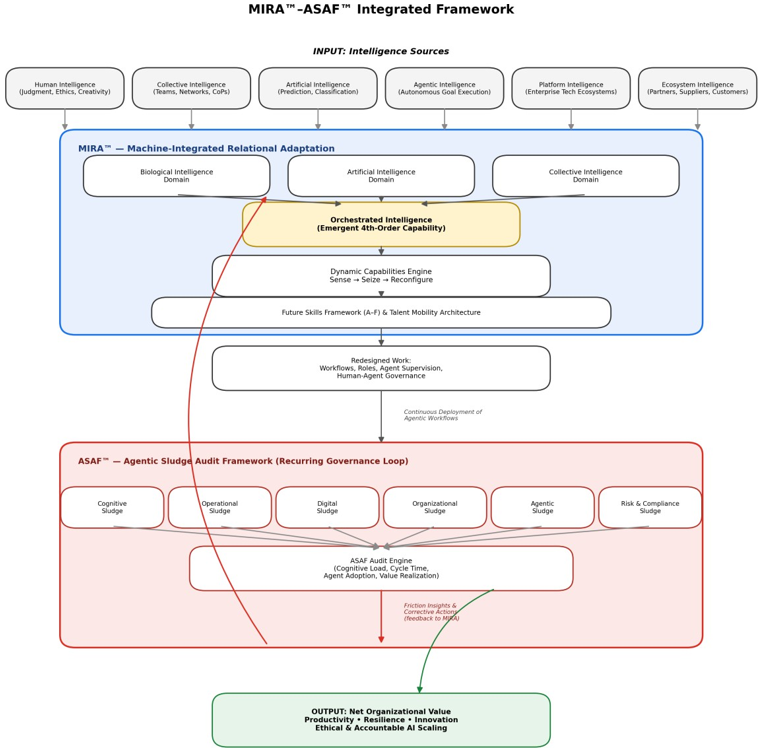 |
| Figure 1: Integrated MIRA™–ASAF™ system architecture. |
Graphical Model of the Proposed Framework
The figure below depicts the integrated MIRA™–ASAF™ system: six intelligence sources feed the MIRA orchestration engine, which drives dynamic capability development and workforce/skills redesign; redesigned, agent-mediated workflows are then continuously monitored by the ASAF governance loop, whose friction diagnostics feed back into MIRA to refine capability-building — producing a closed-loop system oriented toward net organizational value.
Strategic Context: From Digital Transformation to Intelligence Transformation
Enterprise transformation has progressed through three distinguishable waves:
The third wave is defined by value creation emerging from the integration of six intelligence types:
- Human Intelligence: judgment, ethics, creativity
- Collective Intelligence: knowledge distributed across teams and networks
- Artificial Intelligence: prediction, classification, and optimization at machine scale
- Agentic Intelligence: autonomous, goal-directed task execution
- Platform Intelligence: capability embedded in enterprise technology ecosystems
- Ecosystem Intelligence: intelligence generated across partner, supplier, and customer networks
This evolution requires organizations to move beyond technology adoption toward intelligence orchestration — the deliberate coordination of human and machine cognition to generate decisions, knowledge, innovation, and business value. OECD research indicates that AI is reshaping work tasks, skill requirements, and workforce structures across industries and increasing the importance of cognitive, digital, managerial, and social competencies [4], [5]. Field evidence also shows that generative AI can improve worker productivity while producing heterogeneous effects across experience and skill levels [6]. These findings frame intelligence orchestration as an organizational-design and capability-development challenge, not solely a technology-adoption problem.
Program Vision and Mission
Vision: Build future-ready organizations in which humans and intelligent systems continuously learn, adapt, and innovate together.
Mission: Develop an adaptive workforce capable of leveraging Generative AI, Agentic AI, collective intelligence, and platform technologies to improve productivity, resilience, innovation, and organizational performance — while maintaining human agency, accountability, and ethical oversight over autonomous systems.
Conceptual Methodology
Research design. This article employs an integrative conceptual-review design to develop a theory-informed framework rather than to estimate causal effects or report primary empirical findings. The approach is appropriate for connecting constructs that are dispersed across dynamic capabilities, human-AI collaboration, workforce transformation, organizational design, skills development, and AI governance. The unit of analysis is the organizational capability system through which human and machine intelligence are combined, governed, and translated into workforce and performance outcomes.
Evidence scope and selection. The evidence base combines peer-reviewed scholarship, institutional reports, and authoritative conceptual sources that directly inform one or more of four analytical domains: organizational capabilities, work redesign, workforce skills, and agentic-AI governance. Sources were retained when they clarified a focal construct, supplied empirical or theoretical support for a proposed relationship, or enabled operationalization through observable indicators. Sources that were duplicative, peripheral to organizational-level analysis, or insufficiently documented were excluded. Because the review is integrative and purposefully bounded rather than systematic, it does not claim exhaustive coverage of the rapidly evolving agentic-AI literature.
Analytical procedure. The synthesis followed four stages. First, recurring constructs and mechanisms were extracted from the selected evidence. Second, overlapping concepts were consolidated into the intelligence, capability, workforce, and governance domains used in the Machine-Integrated Relational Adaptation (MIRA) framework. Third, anticipated sources of cognitive, operational, digital, organizational, agentic, and risk-and-compliance friction were translated into the Agentic Sludge Audit Framework (ASAF), its audit domains, and its performance measures. Fourth, relationships among orchestration capability, workforce adaptability, human oversight, agent autonomy, audit maturity, and organizational performance were expressed as six propositions that can be evaluated empirically.
Rigor and boundary conditions. Conceptual consistency was assessed by checking that each framework component had a defined organizational function, a plausible mechanism, and a measurable implication. Claims supported by established field or experimental evidence are distinguished from forward-looking propositions concerning multi-agent coordination, organizational structure, and emerging work. The resulting MIRA-ASAF model should therefore be interpreted as an analytically derived design framework that requires longitudinal, cross-industry, and multi-level validation. Its transferability may vary with regulatory context, task interdependence, data quality, workforce readiness, and the autonomy and transparency of the deployed AI systems.
Implications of Agentic AI on the Nature and Types of Work
Agentic AI — autonomous, goal-directed systems capable of planning, tool use, and multi-step execution with limited human supervision [2] — is altering the fundamental unit of work redesign. Four structural shifts are especially consequential for organizational design and workforce strategy.
From task automation to workflow reconfiguration
Earlier generations of AI and RPA automated discrete, well-bounded tasks within a fixed workflow. Agentic systems instead decompose higher-level goals, sequence sub-tasks, invoke tools and other agents, and adapt plans dynamically in response to intermediate outcomes [2], [3]. This shifts the locus of redesign from the task to the workflow. It may also increase demand for responsibilities involving agent supervision, exception handling, workflow assurance, and multi-agent coordination; whether these responsibilities consolidate into distinct occupational categories remains an empirical question [3].
Coordination-cost compression and organizational flattening
Agentic systems may absorb portions of communication, monitoring, task-allocation, and exception-routing work that previously required human coordination. They could therefore alter managerial coordination burdens and feasible spans of control, but this relationship requires direct organizational-level testing. Evidence of hierarchy-wide flattening remains emergent. Field evidence for generative AI demonstrates heterogeneous productivity gains across workers and tasks, suggesting that organizational redesign should be treated as a testable contingency rather than a universal outcome [6].
Endogenous creation of new work, not only displacement of old work
Because agentic systems may lower the cost of coordinating complex activities, they could make responsibilities such as continuous agent supervision, workflow assurance, performance auditing, and cross-agent conflict resolution more feasible. These possibilities are theoretically grounded organizational propositions rather than settled labor-market outcomes. Evidence that AI assistance can diffuse high-performer practices and generate larger gains for less-experienced workers supports examining augmentation, learning, and work redesign jointly [6].
Governance, explainability, and accountability as a distinct occupational function
Because agentic architectures vary widely in transparency — from symbolic, rule-based agents to opaque neural or hybrid architectures — they carry materially different explainability and governance profiles [2]. This variation may increase demand for responsibilities focused on agent governance, auditability, escalation, and accountability. Whether these responsibilities become distinct occupational functions remains an empirical question. These governance needs provide the organizational rationale for the ASAF™ framework introduced in Section 11.
Taken together, these four shifts suggest that workforce planning should move beyond a narrow “which tasks get automated” framing toward examining how workflows, spans of control, competencies, and accountability structures may be redrawn. This proposition underlies MIRA™ and ASAF™ and requires organizational-level validation.
MIRA™: Machine-Integrated Relational Adaptation Framework
Definition
Machine-Integrated Relational Adaptation (MIRA™) is a socio-technical workforce transformation framework describing how humans, AI systems, autonomous agents, and organizational structures continuously co-evolve, learn, and adapt within dynamic business environments. MIRA positions AI not as a substitute for human capability but as an augmentation mechanism that extends organizational adaptability, decision quality, and collective intelligence.
MIRA Core Intelligence Domains
Biological Intelligence — capabilities unique to humans: strategic judgment, ethical reasoning, creativity, emotional intelligence, contextual sense-making, and leadership.
Artificial Intelligence — machine-enabled capabilities: prediction, classification, optimization, automation, and autonomous task execution.
Collective Intelligence — distributed intelligence emerging through teams, knowledge networks, communities of practice, and organizational ecosystems.
Orchestrated Intelligence — the coordinated integration of human, machine, and collective intelligence, structured through governance, workflow design, and shared accountability, to maximize organizational learning, adaptability, and performance. Orchestrated Intelligence is the emergent, fourth-order capability that MIRA is designed to cultivate — it does not exist independently of the other three domains but arises from their deliberate integration.
AI as a Higher-Order Dynamic Capability
MIRA extends Dynamic Capabilities Theory [7], [8] by positioning AI — particularly Generative and Agentic AI — as a higher-order capability that strengthens an organization’s capacity to sense, seize, and reconfigure resources under conditions of uncertainty.
This framing treats AI not as a static tool applied to existing processes, but as a proposed capability that may strengthen the organization’s sensing, decision, and adaptation infrastructure — consistent with Teece’s emphasis on capability renewal as a source of sustained competitive advantage under conditions of uncertainty [7]. The possibility that agentic AI affects coordination structures, rather than only task execution, is advanced here as a testable organizational proposition rather than an established empirical result.
Future Skills Framework
MIRA organizes future workforce skills into six interdependent categories. Categories A–D reflect established taxonomies [1], [4]; categories E and F extend the taxonomy to address emerging agentic and adaptive capability requirements not yet fully codified in mainstream skills frameworks, consistent with the new agent-supervision and orchestration roles discussed in Section 3 [2], [3].
The World Economic Forum identifies analytical thinking, resilience, flexibility, leadership, creative thinking, and AI-related competencies as among the most significant future workforce skills [1].
Enterprise Skills Mapping Framework
Future Skills Competency Matrix
Competency Maturity Levels
Workforce Competency Matrix
Talent Mobility and Workforce Architecture
Traditional model: Jobs → Roles → Functions Future model: Skills → Capabilities → Opportunities → Value Creation
Organizations should establish:
- Skills-Based Talent Architecture — align workforce planning around capabilities rather than static job descriptions.
- AI-Powered Talent Marketplaces — enable intelligent matching between skills, learning opportunities, projects, internal mobility pathways, and career transitions.
- Dynamic Career Pathways — support reskilling, upskilling, cross-skilling, and career reinvention.
Because AI assistance can alter task allocation, learning, and performance differently across workers, organizations should periodically reassess role boundaries and mobility pathways as deployment evidence accumulates [6].
Learning-to-Learn Organization Model
Future-ready organizations develop meta-learning capabilities characterized by:
- Continuous Learning — embedded within workflows, not confined to formal training events.
- Intelligent Learning Systems — AI-powered capability assessments and personalized development pathways.
- Communities of Practice — cross-functional knowledge-sharing networks.
- Continuous Experimentation — rapid testing, learning, adaptation, and scaling.
The OECD identifies continuous learning and workforce adaptation as critical requirements for maximizing AI-related productivity gains and workforce resilience [4], [5].
ASAF™: Agentic Sludge Audit Framework
Purpose
The Agentic Sludge Audit Framework (ASAF™) evaluates possible friction, complexity, decision burdens, and process bottlenecks associated with AI agents, autonomous systems, and intelligent workflows. Poorly governed implementations may introduce workflow complexity, cognitive burden, exceptions, and accountability gaps [2]. ASAF treats these possible effects as auditable risks rather than established universal outcomes.
Definition of Agentic Sludge
Agentic Sludge refers to the cumulative friction, complexity, cognitive burden, workflow inefficiency, process redundancy, governance overhead, and decision latency created by autonomous agents and AI-driven systems.
ASAF Assessment Domains
ASAF Performance Metrics
Note: ASAF is proposed as a recurring audit — conducted at agent deployment, at defined intervals thereafter, and after major workflow changes — because agent behavior, workflow dependencies, user practices, and organizational effects may evolve during deployment. The appropriate audit frequency and its effect on performance require empirical validation.
Testable Propositions
The integrated MIRA-ASAF model generates the following propositions for empirical evaluation:
P1. Intelligence orchestration capability will be positively associated with organizational sensing, seizing, and reconfiguration performance.
P2. Workforce adaptability will mediate the relationship between agentic AI adoption and net organizational value realization.
P3. Explicit human oversight, escalation rights, and decision boundaries will strengthen the positive relationship between agentic AI adoption and workflow performance.
P4. Agent autonomy will be positively associated with cognitive, operational, digital, organizational, agentic, and risk-and-compliance sludge when recurring ASAF audits are absent or weak.
P5. The frequency and maturity of ASAF audits will be negatively associated with decision latency, workflow rework, exception-management burden, and compliance overhead.
P6. The positive effect of the integrated MIRA-ASAF system on organizational performance will be stronger when workforce capability development and agent-governance mechanisms are implemented jointly rather than independently.
Implementation Roadmap
Risks, Limitations, and Governance Considerations
Adoption risk: Skills-based and agentic-governance models require cultural change management; underinvestment in change leadership can stall transformation regardless of framework quality.
Measurement risk: Several proposed KPIs (e.g., “Organizational Resilience Score,” “Dynamic Capability Maturity”) require organization-specific operationalization before they can be reliably tracked.
Governance overlap: ASAF should be coordinated with existing AI risk, compliance, and data governance functions to avoid duplicative oversight structures.
Equity risk: AI-powered talent marketplaces and competency matrices must be periodically audited for algorithmic bias in skills-matching and mobility recommendations.
Accountability risk: As agentic architectures vary in transparency, organizations should map explainability requirements to agent autonomy level before deployment, rather than applying uniform governance across heterogeneous agent types [2].
Framework maturity: MIRA™ and ASAF™ are newly proposed frameworks informed by established research on workforce skills, AI-related labor-market change, workplace productivity, and dynamic capabilities [1], [4]–[8]. Their integrated structure and proposed performance effects have not yet been independently validated. Organizations should treat the initial KPIs as directional targets to be refined through pilot data.
Program Success Indicators
Research Foundation
The MIRA–ASAF framework integrates theories and research from: Dynamic Capabilities Theory, Human-AI Collaboration, Workforce Transformation, Organizational Learning, Collective Intelligence, Skills-Based Talent Management, Platform Ecosystems, and Agentic AI Governance.
The framework conceptualizes Generative AI and Agentic AI as higher-order dynamic capabilities that strengthen organizational sensing, seizing, and reconfiguration capacities, while ASAF provides a governance mechanism to identify and reduce agentic friction, ensuring sustainable value realization.
Conclusion
This conceptual article advances an integrated approach to the agentic-AI-mediated future of work by linking workforce capability development with continuous governance of agent-enabled workflows. MIRA explains how organizations can orchestrate human, collective, artificial, agentic, platform, and ecosystem intelligence to strengthen sensing, seizing, and reconfiguration capabilities. ASAF complements that capability-building logic by identifying cognitive, operational, digital, organizational, agentic, and risk-and-compliance friction that can offset the intended value of autonomous systems. Together, the frameworks position workforce transformation and agent governance as mutually dependent elements of organizational design.
The model has practical value for managers because it connects skills architecture, human oversight, workflow redesign, recurring audit activity, and performance measurement in a closed-loop implementation approach. However, MIRA and ASAF are analytically derived frameworks rather than empirically validated causal models. Their effects may vary by industry, regulatory environment, task interdependence, data quality, workforce readiness, and agent autonomy. The six propositions therefore establish a future research agenda involving longitudinal, cross-industry, and multi-level studies. Such research should test whether joint investment in workforce adaptability and recurring governance produces stronger and more sustainable organizational value than either intervention implemented independently.
Declarations
Acknowledgments
The author acknowledges the use of generative AI tools for language editing, structural organization, and source-discovery support. The author reviewed and approved the final manuscript and remains responsible for its accuracy, originality, interpretations, and conclusions.
Funding Support
No external funding was received for this study.
Conflict of Interest
The author declares no conflict of interest.
Data Availability
No original datasets were generated or analyzed because this article presents a conceptual synthesis.
Ethics Statement
Ethical approval was not required because the study did not involve human participants, animals, or identifiable personal information.
AI Use Statement
This document was developed with the assistance of generative AI tools, which supported structural organization, and synthesis of publicly available research.
References
- World Economic Forum, “The Future of Jobs Report 2025,” World Economic Forum, Geneva, Switzerland, 2025. [Online]. Available: https://www.weforum.org/publications/the-future-of-jobs-report-2025/
- M. Abou Ali, F. Dornaika, and J. Charafeddine (2026) “Agentic AI: A comprehensive survey of architectures, applications, and future directions.” Artificial Intelligence Review, 59: 11.
- C. Masters, A. Vellanki, J. Shangguan, B. Kultys, J. Gilmore, A. Moore, and S. V. Albrecht (2025) Orchestrating human-AI teams: The manager agent as a unifying research challenge.” arXiv:2510.02557. Accepted for oral presentation at the Conference on Distributed Artificial Intelligence (DAI 2025), London, UK.
- Organisation for Economic Co-operation and Development, “AI and skills,” OECD Publishing, Paris, France, 2025.
- Organisation for Economic Co-operation and Development, “Skills in the AI age,” OECD Artificial Intelligence Papers, no. 60, OECD Publishing, Paris.
- E. Brynjolfsson, D. Li, and L. R. Raymond (2025) “Generative AI at work.” Quarterly Journal of Economics, 140: 889–942.
- D. J. Teece, “Explicating dynamic capabilities: The nature and microfoundations of (sustainable) enterprise performance,” Strategic Management Journal, vol. 28, no. 13, pp. 1319–50, 2007.
- D. J. Teece (2025) Dynamic Capabilities: Foundational Concepts. Cambridge: Cambridge University Press.
Article Information
Conceptual Review Article
Received Date: September 29, 2026
Accepted Date: October 17, 2026
Published Date: October 20, 2026
The MIRA™–ASAF™ Program for Workforce Transformation and Agentic Governance
Volume 2 | Issue 1
Citation
Yohannes Haile (2026) The MIRA™–ASAF™ Program for Workforce Transformation and Agentic Governance. 2: 102.
Copyright
©2026 Yohannes Haile. This is an open-access article distributed under the terms of the Creative Commons Attribution License, which permits unrestricted use, distribution, and reproduction in any medium, provided the original author and source are credited.
doi: jbme.2026.2.102