


Review Article
Volume-1 Issue-1, 2021
Retrospective Clinical Studies: Surgical Treatment and Quality of Life in Patients Undergoing in Lumbar Arthrodesis Surgery
Received Date: September 12, 2021
Accepted Date: October 12, 2021
Published Date: October 12, 2021
Journal Information
Abstract
Objective
Measure, compare and psychometrically analyse the evolutionary results of instrumented arthrodesis surgical technique, performed in patients with low back pain from degenerative disease by quality of life questionnaire.
Material and MethodsRetrospective Study Of ninety-eight patients undergoing lumbar fusion technique surgery for degenerative lumbar pathology. 30-77 age years (39 men and 57 women). The study period pre-surgery, post-surgery: two to eight years, used SF36, DEYO and ODI questionnaires.
ResultsIncreased quality Of life Of patients being two to eight years, presenting a general improvement, pain and disability reduction. SF36 the dimensional score up to seven at two years (p < O.O5). Oswestry Disability Index from 44.6 ± 16.8 disabilities passes 35.7 ± 23.1 (two years -9.2% disability) and 38.3 ± 21.5 (eight years -5.8% disability). Outcomes Core Measures Index improvement is obtained in all items 76.29 ± 1.11 to 57.4 ± 1.41 (2 years; -22.6% disability) and 57.4 ± 1.29 (eight years; -18.9% disability).
Key words
Low back pain; Quality of Life; Functional Capacity; Lumbar Arthrodesis; SF36; DEYO; ODI
|
Mean |
Total mean |
Patient total |
Age–Yr |
<65* 49,73±9,68 >65 69,73±5,12 |
56,60±12,68 |
66(67%) 32(33%) |
Sex |
Male 39(40%) |
Female 57(60%) |
|
Vertebral fixation ** |
|
||
|
Pre-surgery |
2 Age |
8 Age |
SF-36 |
0,46 |
0,25 |
0,07 |
ODI |
0,43 |
0,50 |
|
COMI |
0,90 |
0,33 |
|
Pre-surgery |
2 Age |
8 Age |
2-8 |
|||||
Mean |
Mean |
Difference** |
P |
Mean |
Difference** |
P |
P |
||
Physical functioning |
28,88±9,25 |
|
35,14±12,23 |
6,26 |
,00 |
31,87±11,72 |
2,99 |
,04 |
,00 |
Physical role |
30,59±8,09 |
35,72±12,23 |
5,13 |
,00 |
34,33±11,31 |
3,74 |
,01 |
,16 |
|
Bodily pain |
30,12±7,21 |
|
37,21±10,31 |
7,09 |
,00 |
33,12±9,27 |
3 |
,00 |
,00 |
General health |
41,48±9,12 |
|
40,82±10,36 |
-0,66 |
,70 |
37,45±10,28 |
-4,03 |
,64 |
,00 |
Vitality |
34,68±9,83 |
|
39,68±9,40 |
5 |
,00 |
35,60±10,23 |
0,92 |
,63 |
,00 |
Social role |
31,84±13,6 |
|
35,36±15,69 |
3,52 |
,37 |
32,58±16,30 |
0,74 |
,00 |
,05 |
Emotional role |
37,12±15,1 |
|
39,98±15,42 |
2,86 |
,16 |
41,11±15,36 |
3,99 |
,78 |
,65 |
Mental health |
39,70±11,1 |
39,34±7,48 |
-0,36 |
,81 |
40,25±12,49 |
0,55 |
,17 |
,89 |
|
ITEM |
Pre-surgery |
2 Age |
8 Age |
2-8 |
||||||||||
|
Mean |
Mean |
Difference |
P |
Mean |
Difference |
P |
P value |
||||||
Pain intensity |
2,97±1,16 |
2,45±1,45 |
10,40 |
,00 |
2,45±1,39 |
10,40 |
,00 |
1,00 |
||||||
Standing |
3,02±1,23 |
2,44±1,39 |
11,60 |
,00 |
2,59±1,50 |
8,60 |
,01 |
,30 |
||||||
Personal care |
1,79±1,25 |
1,53±1,32 |
5,20 |
,06 |
1,47±1,38 |
6,40 |
,04 |
,67 |
||||||
Sleeping |
1,46±1,43 |
1,05±1,15 |
6,20 |
,01 |
1,14±1,19 |
6,40 |
,07 |
,24 |
||||||
Lifting |
2,95±1,17 |
3,29±1,22 |
-6,80 |
,01 |
3,15±1,22 |
-4,00 |
,14 |
,44 |
||||||
Sex life |
2,44±1,58 |
2,05±1,84 |
7,80 |
,04 |
2,15±1,88 |
5,80 |
,35 |
,54 |
||||||
Walking |
1,86±1,35 |
1,51±1,44 |
7,00 |
,12 |
1,53±1,64 |
6,60 |
,16 |
,53 |
||||||
Social life |
2,88±1,34 |
2,04±1,61 |
16,80 |
,00 |
2,43±1,60 |
9,00 |
,02 |
,00 |
||||||
Sitting |
1,96±1,47 |
1,65±1,27 |
6,20 |
,02 |
1,60±1,04 |
7,20 |
,00 |
,54 |
||||||
Travelling |
1,15±1,05 |
1,84±1,57 |
-13,80 |
,05 |
2,00±1,60 |
-17,00 |
,00 |
,53 |
||||||
Total mean item *** |
2,24±1,30 |
1,98±1,43 |
|
|
2,05±1,44 |
|
|
|
|
|||||
total disability % |
44,9±16,8 |
35,9±23,1 |
|
39,1±21,5 |
|
|
|
|
||||||
|
|
|
2 Age |
|
|
8 Age |
|
|
2-8 Age |
|||||
reduced total |
|
|
9,2 |
|
|
|
5,8 |
|
|
|
|
-2,6 |
||
ITEM |
Pre-surgery |
2 Age |
8 Age |
2-8 * |
||||||||
|
Mean |
Mean |
Difference |
P |
Mean |
Difference |
P |
P |
||||
1) DURING THE LAST WEEK HAS MUCH DISTURBED BACK |
4,21±,87 |
3,15±1,38 |
21,20 |
,00 |
3,54±1,17 |
13,4 |
,00 |
,01 |
||||
2) During the last week how much it bothered leg pain |
3,72±1,27 |
2,55±1,40 |
23,40 |
,00 |
3,12±1,42 |
12,0 |
,03 |
,00 |
||||
3) During the past 4 weeks until PAIN LE POINT she has hindered their regular work? (INCLUDING THE WORK OUT |
4,05±1,09 |
3,03±1,50 |
20,40 |
,00 |
3,38±1,47 |
13,4 |
,00 |
,05 |
||||
4) How would you feel VD. |
4,82±,54 |
3,36±1,42 |
29,20 |
,00 |
2,03±1,16 |
55,8 |
,00 |
,00 |
||||
5) During the past 4 weeks |
3,42±1,61 |
2,54±1,68 |
17,60 |
,03 |
2,60±1,45 |
16,4 |
,01 |
,86 |
||||
6) During the past 4 weeks |
3,31±1,87 |
1,90±1,51 |
28,20 |
,00 |
2,17±1,46 |
22,8 |
,00 |
,05 |
||||
7) AS OF SATISFIED WITH |
2,94±1,13 |
2,24±1,21 |
14,00 |
,00 |
3,01±1,17 |
-1,4 |
,90 |
,00 |
||||
Total mean item |
3,78±1,20 |
2,69±1,14 |
|
|
2,87±1,33 |
|
|
|||||
total disability % *** |
76,29±1,11 |
53,7±1,41 |
|
|
57,4±1,29 |
|
|
|||||
|
|
|
2 Age |
|
8 Age |
|
2-8 Age |
|||||
reduced total disability % |
|
|
22,6 |
|
|
18,9 |
|
|
- 3,7 |
|||
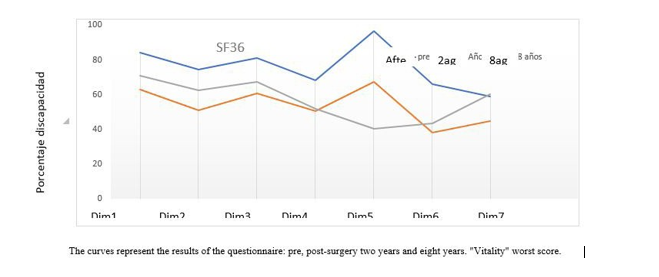 |
| Figure 1: Comparison of each dimension of Sf 36 and the three phases of the questionnaire |
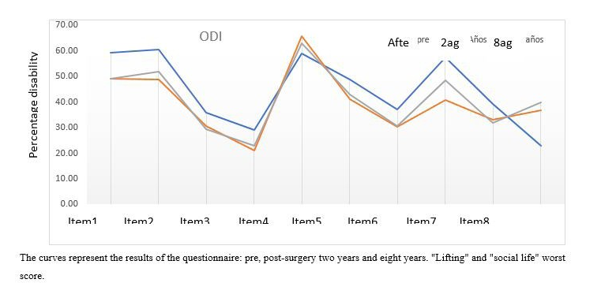 |
| Figure 2:Compare each item in the ODI and the three phases of the questionnaire |
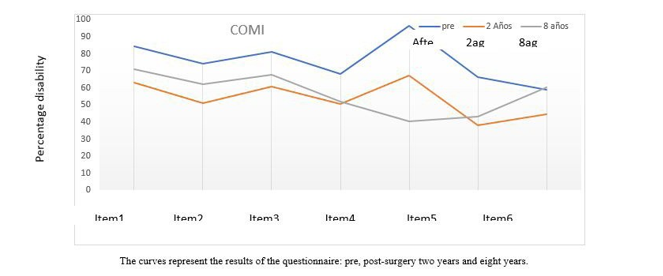 |
| Figure 3:Comparison of each item of COMI and the three phases of the questionnaire |
Introduction
Chronic low back pain is the leading cause of activity limitation arid is the most prevalent in over 65 musculoskeletal pathology [4-13].
The classic surgical treatment of chronic low back pain by disc degeneration has arthrodesis. The benefit is based on the lumbar pathology originates abnormal mobility between vertebral segments and adjacent segments suffer greater mobility fixing [10].
The clinical measurement Of muscle strength and range Of motion not many correlated with actual patient's symptoms. Commonly used medical assessments are highly subjective and do not distinguish capabilities that can improve.
A direct measure Of patient status is needed then. In this paper the improvement Of health and functional capacity (CF) using instruments that provide a standardized measure, the completeness, reproducibility and validity are discussed [18, 14].
The quality Of life (QOL) is related to health and health conditions Of persons referred from the subjective experiences Of them on their overall health [11, 14].
The aim ofthisstudy istomeasure, compareand psychometrically analyze the evolutionary results Of instrumented arthrodesis technique, performed in patients with low back pain from degenerative disease through questionnaires quality of life and functional capacity; measurements on different aspects of health: physical, psychological and social.
Hypothesis
Null hypothesisChanging results (two to eight years) after surgery for degenerative lumbar pathology, in terms of CV and disability, do not change over time.
Primary HypothesisThe change Of result (two to eight years) following surgery for degenerative lumbar pathology, in terms Of CV and disability are influenced by the course Of time.
Material and Method
Of deciento sixty-three patients undergoing surgery for degenerative lumbar pathology at Hospital del Mar (Department of Orthopedic Surgery and Traumatology) between 2005 and 2013, a retrospective study of ninety-eight patients undergoing surgery is performed using technique of lumbar arthrodesis using data available in the database Of data.
The aged 30-77 years (39 men and 57 women) With a mean age Of 56.6 years and a variable number Of segments (Table 1).
The Study period was: pre surgery, post-surgery at two and eight. Questionnaires CV and functional capacity (FC) were used.
The inclusion criteria used: lumbar arthrodesis intervention at any level, not having similar intervention previous and had not improved with conservative treatment.
Excluded: patients with barrier, metabolic bone disease, active infection, rheumatic diseases, primary tumor or metastasis and contraindication for anesthesiological criteria.
The pathology diagnosis was carried out by cli nical examination arid MRI.
The study was approved by the research committee of the center, All were adequately informed of the benefits and risks of intervention and signed the informed consent specific.
The operations were performed under general anesthesia and prone.
Questionnaire used in the studyPatients were assessed by self-questionnaires administered versions validated in Spain, with Medical Outcomes Study Short Form 36 versione 2 (SF36 v2), Oswestry Disability Index (ODI) and Core Outcomes Measures Index DEYO (COMI), preoperatively, two and eight years after surgery.
The SF36 evaluates different aspects Of health [9]; adapted in Spain by J. Alonso et al. The score can range from a minimum Of O to a maximum Of 100. The normal values would be within a range between related to each dimension, age and sex (14]. less than fifty scores indicate poorer level Of health.
The ODI, equivalent to Roland-Morris. The total score, expressed as a percentage (O to m) [61, (Total Points/50- (unanswered questions)) XIOO disability [5]
COMI is characterized by seven questions to assess the five- item disorder of the lumbar spine. The seven survey questions provide results from 1 to 5; 1 is the best possible outcome.
This set of questionnaires related to some excellent psychometric characteristics in patients with low back pain that surgical treatment [8] was performed.
Statistical analysis
The statistical used for assessing the scale were the mean, standard deviation.
Statistical analysis was performed using SPSS 18.0 (SPSS Inc., Chicago, IL) and Microsoft EXEL 2013. The results Of quantitative variables were compared using the Student t test double tail. All 98 patients enrolled in the Study completed the three questionnaires.
Results with a value Of p < O.O5 was considered statistically significant. differences between the curves Of major and minor subset Of patients sixty-five years applying the T Student (table 2) was found. The difference between the means was not significant By this age as a variable that could introduce bias was discarded.
Results
The average age of the operated patients was 56.6 years (between 30 and 77 years). The ninety-eight patients selected, 66% are under sixty-five and 66% of the total are women. Seventeen patients have less than forty-five yea rs (Table 2) age.
The three questionnaires give us consistent results related to the quality Of life Of patients over two to eight years, presenting a general improvement, pain and autonomy (greater sensitivity the COM l). It calculates the difference between the result Of the items and dimensions Of the third phase Of the questionnaires (difference in percentage) NO Significant difference was seen Surgery two and eight years (p> 0.05).
In the middle Of the bcxdy curves patients with lower and higher age sixty-five years applying Student T with 95% not significant (Table 2). It then Checks that there is no difference by age.
Comparing SF36 have an overall improvement between one and seven points at two years (Table 3). The "physical function" improvement Of 7 from 28.8 to 35.1; physical pain from 30.1 to 37.7 (p < O.O5); "vitality" and "social function" increases almost five points (p < O.O5). It remains stable "mental health" (results are significant) and the "general health", remaining to the pre-surgery values. Eight years did not observe an improvement over the two years; It highlights a worse score Of "physical function" (31.8) and a Slight improvement Of the "mental health" (40.2) for two years. The "physical performance" improvement 5,13 points (two years) and 3.7 (eight years), p < 0.05. The "pain" improved 7.09 points to two years and down 3 points to eight years, p < 0.05. The "general health" is worse after surgery for eight years with p> 0.05.
The ODI (Table 4) from an initial 44.6 ± 16.8 disability is reduced to 35,7 ± 23,1 at two years (9.2 points) and 38.3 ± 21,5 to eight years (5.8 points).
All items are significant except for the "walk" care two years, and neither are "sexual activity" and "sleep", "lift weights" at eight years (p < 0.05), Yet the "sleep" and walk have differential score is to eight years two and 6.4; and 7 and 7.6), Life", "stand" and "pain intensity" have the best score of all items 16,8 and 9; 11,6 and 8.6; 10.4 and 10.4 (two to eight years with p < 0.05). The "pain" improved 10.4 points to two to eight years (p < 0.05). The "travel" and "lifting" have a negative difference, you do not experience an improvement after treatment (-13.8 and -17, -6.8 and -4). Although the "heavy lifting" is not significant at eight years (p>0.05).
NO item is significant between two and eight years. At eight years Of disability obtained difference, it is reduced to 2.6%. The COMI an improvement is obtained in all seven item in two to eight years with p < 0.05. Total disability passes from 76.29 ± 1.11 to 57.4 ± 1.41 to two years (22.6% less disability) and 57.4 ± 1.29 to eight years (18.9% less disability). It has exception seventh item where disability increased 1.4 but with 0.05 appears only eight years. The results have particularly demonstrative fourth item with a value of 55.8 and 28.2 sex with eight years. The lowest was the seventh item related to treatment satisfaction. Comparing the results, total disability decreases between two and eight years is -3.7% with p < 0.05 in all the meaning of the fifth item to item.
Calculation of the differential ratingTo calculate the differential rating has used the following rule: initial ratings in percentage of each item / dimension - Final score percentage of each item / dimension. The results are the rating earned after surgery.
Discussion
The health-related CV is used to evaluate health-related variables from the perspective of the individual, This study has determined how clinical outcomes evolve as time elapses after surgery and describing the mean values of quantitative fundamental variables that define the clinica I Status Of the patient in pre and post-surgical different years [1].
The SF36, ODI and COMI showed an overall improvement in CV and CF with a reduced degree of disability (Figure 1,2,3)
On average and dispersions Of each item that makes up the scale SF36 ordered by sub-dimensions it is observed that these patients have limited the development Of their daily physical activities. For the improvement in clinically meaningful treatment opinions vary between four an d sixteen points according to ten according to Other authors [8, 151 in ODI- COMI and SF36 point seven [17].
In the SF36 note that the patient has a slight decrease in health status in relation to the fifth question in the questionnaire, while COMI health status and disability is assessed in the fourth question which seems an improvement in these parameters at two and eight years.
Regarding the evolution of pain, in relation to the patient's of their frequency and intensity, is valued at SF36 in the fourth question, in ODI first question, and the first and second question COMI, all parameters different questionnaires improved significantly.
Improving the "physical function" of the SF36 (the impact of physical limitations on daily activities and the fulfillment of their prcxiuctive tasks), related to this area the can be found in ODI item two, three, seven, with than improvement the seven points, COMI the three fifth and sixth
The degree to which the disease interferes with the "social life" and "emotional" patient has a significant social impact on SF36, Mild improvement after treatment but with may mean that the questionnaire resgxmses have been very varied; Item eighth ODI positive (16.8 points) and sexual activity (7.8 points) at two years; respectively in the fourth item COMI is similar with significant reduction (over 20 points).
Mental health includes the recognition of the effect it can have the disease on anxiety, depression and mood of the patient, also it remains low after treatment with p> 0.05. Probably caused by high expectation of improvement that had patients.
"Vitality" in SF36 has a positive value particularly at two years (worth five). Analogous COMI the fifth item. The dimension "general health" remains almost the same, probably related to Chronic diseases. COMI something related in the 6 item with results.
In the seventh item COMI is no good treatment received satisfaction at two years.
Overall improvement in CV and decreased pain remain for long: in *36, ODI item first item COMI first and seconded. Those who are not improved in ODI: "lifting" and "travel"; The "sleep" and "walk with" good score two to eight years (consistent with item "pain"), but they are probably not significant relating to N.
These results are similar to findings in other studies of similar populations who have used the SF36 [17].
Conclusions
The result after surgery for degenerative lumbar pathology regarding disability CV and more short-term improvement.
The result of the surgery is indicated if it meets patient expectations
The age Of patients is not a contraindication to surgical (2).
Study limitationsOne limitation Of the Study was a small number Of case (N), higher N would have given more precise information and more narrow curves.
It considers that the questionnaires did not include some health concepts: cognitive, family function.
The number of patients at levels set was not sufficiently broad to determine the influence they can have this variable.
StrengthThe strength of the study is related to the use of standard psychometric questionnaires and proven friability, sensitivity, accuracy.
Clinical Study in patients
Long study
Cross different tests
As a point of reference literature confirms the results obtained.
References
- D Perez, C Lonzano, G Salo, A Molina, A Llado, L, et al. (2014) should age a contraindication for degenerative lumbar surgery? Eur Spine j 23:1007-12
- C Lonzano, D Perez, G Salo, A Molina, A Clado, et al. (2014) can epidemiological factor affect the 2 year outcomes alter surgery for degenerative lumbar disease in terms Of quality Of life, disability and post-surgical pain? Rev esp Cir ortop traumatol 58:78-84
- CD Fankhauser, U Mutter, E Aghayev, AF Mannion (2012) Validity and responsiveness Of the Core Outcome Measures Index (COMI) for the neck. Eur Spine J 21: 101-14
- D Kok, M Grevitt, F Wapstra, A Veldhuizen (2012) The Memory Metal Spinal System in a Posterior Lumbar Interbody Fusion (PLIF) Procedure: A Prospective, Non-Comparative Study to Evaluate the Safety and Performance. Open Orthop J 6:220-5.
- E Thornes, N Ikonomou, M Grotle (2011) Prognosis of Surgical Treatment for Lumbar Spinal Stenosis: A Prospective Cohort Study of Clinical Outcomes and Health- Related Quality of Life Across Gender and Age Groups The Open Orthop J 5:372-8
- CD Fankhauser, U Mutter, E Aghayev, AF Mannion (2011) Validez y capacidad de respuesta del nücleo Medidas de Resultados indice (CIP) para el cuello. Eur Spine J diciembre de 21: 561
- M Rodriguez, F Sancho, F Campos, O Lopez, F Muöoz Clinical and occupational outcomes of interspinous implants versus instrumented posterolateral arthrodesis in the treatment of lumbar disc disease. Two years of follow-up. 20: 144-50 Trauma Fund MAPFRE.
- MR Vidal, M Merino, MC Salas (2m9) Psychometric assessment of the physical and mental components of the SF- 36 in chronic renal insufficiency failure patients in treatment with hemodialysis. Ciencia y Enfermeria XV: 75-88.
- R Postigo, A Lisoni (2008) Enfermedad del segmento adyacente secundaria a instrumentaciån en cirugia de la columna lumbar. Rev. medica N19 2:152.
- JC Soriano (Ü7) Prospective Study Of clinical results and prognostic factors in instrumented lumbar arthrodesis. Economic and cost-effectiveness analysis. Doctoral thesis Madrid. Autonomous University Of Madrid, department Of surgery.
- LH Lugo, HI Garcia, C G6mez Reliability of sf-36 quality of life in health questionnaire in Medellin, Colombia Rev Fac Nac Public Health 24: 2
- A Bumbiedro, MT Garcia, CE Pérez, F. Pérez Oswestry low back pain disability questionnaire. Vole 40. Nime 03, Mayo 2006 doi: 10.1016/S0048-7120(06)74881-2
- AG Conesa, SV Moya (2W5) Chronic low back pain and disability at work. Fisioterapia 27:255-65
- G Vilagut, M Ferrer, L Rajmil, P RebollO, G Permanyer, et al. (2005) El Cuestionario de Salud SF-36 espaåol: una década de experiencia y nuevos desarrollos. Gac Sanit. 2025;19(2):135-607.
- P Pulido Rivas, RG Sola, JM Pallares-Fernåndez, A Pintor Escobar Lumbar spine surgery in elderly patients REV NEUROL 39:501-7
- RA Deyo, M Battie, AJ Beurskens, C Bombardier, P Croft, et al. (2003) Outcome measures for low back pain research. A proposal for standardized use. Spine (Phila Pa 1976).23: 13.
- R Deyo (1988) Measuring the functional Status Of patients with low back pain. Arch Phys Med Rehabil 69: 1044-53.
Artcle Information
Review Article
Received Date: September 12, 2021
Accepted Date: October 12, 2021
Published Date: October 12, 2021
Journal of Bone Research and Orthopaedic Surgery
Volume 1 | Issue 1
Citation
Antonio Molina Ros, Alejandro del Arco Churruca, G Sald BruFull Name, Gema Vila, G Musumeci (2021) Retrospective Clinical Studies: Surgical Treatment and Quality of Life in Patients Undergoing in Lumbar Arthrodesis Surgery. J Bone Res Orthop Surg 111-11
Copyright
©2021 Antonio Molina Ros. This is an open-access article distributed under the terms of the Creative Commons Attribution License, which permits unrestricted use, distribution, and reproduction in any medium, provided the original author and source are credited.

doi: jbos.2021.1.101