


Review Article
Volume-1 Issue-1, 2021
Is Vermicomposting Financially Viable? Empirical Evidence from Sidama Regional State, Ethiopia
Received Date: April 21, 2024
Accepted Date: May 21, 2024
Published Date: May 24, 2024
Journal Information
Abstract
Vermicomposting is a biotechnological method of composting that uses specific earthworm species to speed up the waste transformation process and yield a useful final product. The current study is founded on original data gathered from 21 producers of vermicompost. The districts of Dale and Shebedino in the Sidama region were specifically chosen for this investigation. With the use of thoroughly thought-out and pretested interview schedules, the data was gathered through in-person interviews. The constructed method of vermicomposting, ETB 79937.6, had a larger per household net income on total cost than the vermibed method, or ETB 33096.3. The built approach had a greater benefit-cost ratio (1:2.5) than the vermibed method (1:1.8). These ratios show that the built approach performs better than the vermibed method.
Key words
Vermicompost; Constructed Method; Vermibed; Cost; Net Income; Gross Income
Variable |
Mean (N=21) |
Std. Dev. |
Min |
Max |
Age of household |
40.81 |
9.114 |
28 |
60 |
Education level of the household |
8.524 |
1.569 |
6 |
13 |
Family size |
7.19 |
3.234 |
4 |
16 |
Family age less than 15 years |
2.619 |
2.519 |
0 |
11 |
Family age between 15-64 years |
4.429 |
2.014 |
2 |
8 |
Family age greater than 64 years |
.095 |
.436 |
0 |
2 |
Source: Own data collection, 2023
Variable |
N |
Mean |
Std. Dev. |
Min |
Max |
Input materials cost in ETB/kg |
21 |
.373 |
.329 |
.003 |
1.25 |
Input materials cost in ETB/kg |
14 |
.45 |
.344 |
.1 |
1.25 |
Input materials cost in ETB/kg |
6 |
.242 |
.269 |
.003 |
.75 |
Input materials cost in ETB/kg |
1 |
.083 |
. |
.083 |
.083 |
Source: Own data collection, 2023 |
|||||
Variable |
Mean (N=21) |
Std. Dev. |
Min |
Max |
Input materials cost in ETB/kg |
1.8 |
1.48 |
.003 |
5.36 |
Earthworm variable cost in ETB/kg |
535.7 |
137.06 |
300 |
1000 |
Earthworm fixed cost in ETB/kg |
10456.7 |
9870.47 |
850 |
42000 |
Source: Own data collection, 2023
Purpose of the vermicompost production? |
Where is the destination market for the above products? |
||||
GOs |
NGOs |
Farmers /Neighbors |
No sale yet |
Total |
|
For own production and sale |
1 |
9 |
6 |
3 |
19 |
|
(5.26) |
(47.37) |
(31.58) |
(15.79) |
(100.00) |
Not yet started sale |
1 |
0 |
0 |
1 |
2 |
|
(50.00) |
(0.00) |
(0.00) |
(50.00) |
(100.00) |
Total |
2 |
9 |
6 |
4 |
21 |
|
(9.52) |
(42.86) |
(28.57) |
(19.05) |
(100.00) |
Marketing channels of vermicompost and earthworm
Items |
Per household |
||
For house constructed(N=14) |
For Vermibed(N=6) |
Overall(N=21) |
|
Overall Total cost |
52248.1 |
41837 |
88007.5 |
Overall revenue |
132185.7 |
74933.3 |
181116.7 |
Net revenue |
79937.6 |
33096.3 |
93109.2 |
BCR |
2.5 |
1.8 |
2.1 |
Source: Own data collection, 2023
Production constraints |
Percent of responses(N=21) |
No response |
23.6 |
Ants or natural enemy |
20.8 |
High Construction cost |
6.9 |
Labor intensive |
6.9 |
Lack of Sieve material |
1.4 |
Lack of financial support |
16.7 |
Lack of material |
1.4 |
Lack of shade preparation mat |
1.4 |
Lack of storage |
1.4 |
Lack of training |
2.8 |
Lack of transportation |
1.4 |
Lack of water source |
1.4 |
Production cost |
5.6 |
Shortage of production materials |
5.6 |
vermicompost production house |
2.8 |
Total |
100.0 |
Source: Own data collection, 2023
Market constraints |
Percent of responses (N=21) |
No response |
32.2 |
Lack market place |
10.2 |
Lack of demonstration site |
3.4 |
Lack of know-how and awareness |
10.2 |
Lack of market linkage |
35.6 |
Shortage of transportation |
8.5 |
Total |
100.0 |
Source: Own data collection, 2023
Variable |
Obs |
Mean |
Std. Dev. |
Min |
Max |
Input materias cos~B |
14 |
5028.571 |
3069.059 |
3000 |
15000 |
Amount earthworm c~B |
14 |
2100 |
1286.618 |
500 |
4000 |
Labor cost in ETB |
14 |
15257.143 |
18377.095 |
1650 |
72000 |
land rent |
14 |
6042.857 |
8949.406 |
300 |
30000 |
Vermicompost house~t |
14 |
17057.143 |
15103.22 |
0 |
50000 |
Vermished cost |
14 |
1471.429 |
2930.589 |
0 |
10000 |
Vermitank bed box ~t |
14 |
1428.571 |
2525.692 |
0 |
8000 |
Implements cost |
14 |
444.286 |
1109.572 |
0 |
4000 |
Source: Own data collection, 2023
Variable |
Obs |
Mean |
Std. Dev. |
Min |
Max |
Input materias cos~B |
6 |
6791.667 |
6542.967 |
500 |
15000 |
Amount earthworm c~B |
6 |
1383.333 |
1783.723 |
500 |
5000 |
Labor cost in ETB |
6 |
11586.667 |
6657.827 |
2700 |
21600 |
land rent |
6 |
4200 |
4317.407 |
200 |
12000 |
Vermicompost house~t |
6 |
0 |
0 |
0 |
0 |
Vermished cost |
6 |
10053.333 |
7737.51 |
2500 |
25000 |
Vermitank bed box ~t |
6 |
4166.667 |
7859.177 |
0 |
20000 |
Implements cost |
6 |
918.333 |
2009.979 |
0 |
5000 |
Source: Own data collection, 2023
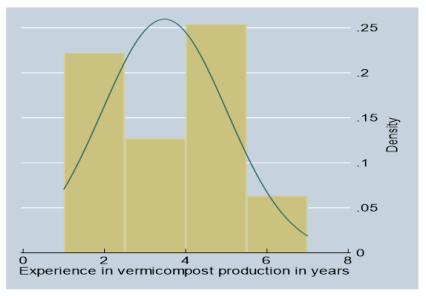 |
| Figure 1: Experience in vermicompost production in years Source: Own data collection, 2023 |
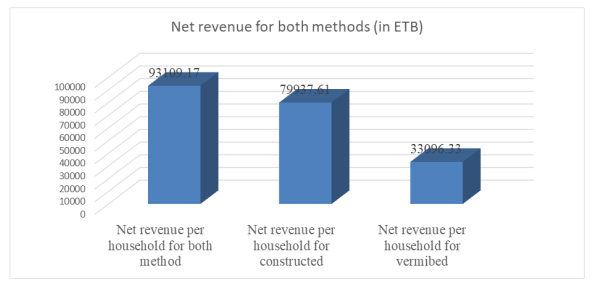 |
| Figure 2:Net Revenue for Constructed, Vermibed and overall methods of vermicompost production Source: Own data collection, 2023 |
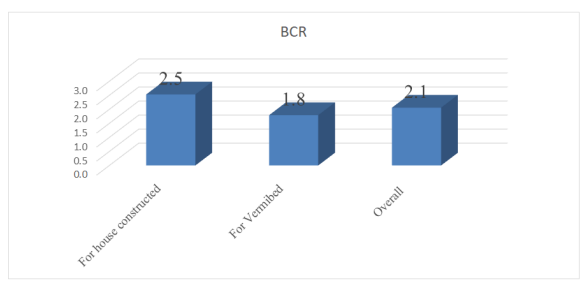 |
| Figure 3:Benefit Cost Ratio for both vermicompost production Scenarios Source: Own data collection, 2023 |
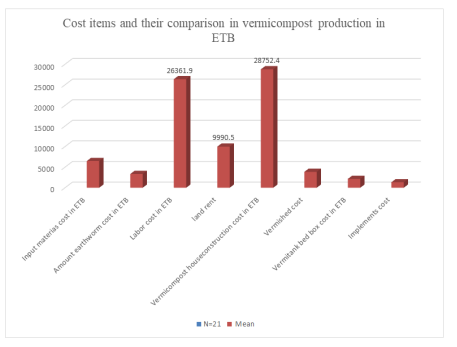 |
| Figure 4: Benefit Cost Ratio for different vermicompost production Scenarios Source: Own data collection, 2023 |
Introduction
For the majority of people on the planet, especially in emerging and poor nations, agriculture is their main source of income [1,2]. Additionally, agriculture provides the majority of the world's food [3]. The agricultural sector, the environment, and the food chain are all suffering irreversibly from the fastdissolving agricultural soil [4]. Moreover, the majority of farming is intensive farming, which uses chemical fertilizers and constant tillage to deplete farm soil of minerals and damage its texture [5]. Vermicomposting, also referred to as earthworm technology, is the process of using earthworms to bioconvert organic materials, while vermiculture is the process of raising earthworms on organic material [6]. Vermicomposting can help save resources, safeguard the environment and people, increase the circularity of farming activities and its ecological imprint, and meet farmers' income needs [7]. [8,9] In addition to treating organic waste, vermicomposting lowers expenses and increases income for farmers [10].
Vermicompost is a type of organic fertilizer that is produced by using earthworms to decompose organic waste, such as cow dung, leafy materials, kitchen scraps, etc. Vermicompost has many benefits for soil health and crop productivity, such as improving soil structure, water retention, nutrient availability, and microbial activity.
Fertilizers, both artificial and organic, are essential for improving crop yield and preserving soil health. However, high costs for chemical fertilizers also caused farmers to apply them less frequently, which decreased Ethiopia's crop yield. Therefore, it is imperative to encourage the use of organic fertilizers in order to maintain the productivity of lands and crops. One way to make enriched compost using earthworms is by vermicomposting. However, there are scanty studies in dealing with the investigation of the cost–benefit analysis and financial viability of vermicompost investment. The economic potential of the technology has been largely remained indefinable and households are mostly seen to be doubtful to invest in it. To increase the production and also use of vermicompost, the return from the vermicompost production should be evaluated whether it is profitable, and the households should be confident on it. Thus, this study is initiated to evaluate the profitability of current and future vermicompost production in Sidama region of Ethiopia.
Objective
● To study the economics of production and marketing of vermicompost in Sidama region, Ethiopia.
● To assess financial viability of average size vermicomposting firm.
● To determine the appropriate marketing channel of vermicompost.
Methodology
Study Areas
The study was conducted in Dale and Shebedino district of Sidama regional state. These districts are selected purposively since maximum producer are involved in vermicompost production. Dale woreda is located in the Great Rift Valley and is bordered by Aleta Wondo, Aleta Chuko, Loko Abaya, Boricha, Shebedino, and Wensho. Shebedino woreda is also located in the Great Rift Valley and is bordered by Dale, Boricha, Awasa Zuria, Gorche, and Wensho woredas.
Sampling and Data collection
Primary data were collected from the sample vermicompost producers through survey method and personal interview with the help of pre-tested well prepared interview schedules covering various aspects to answer the objectives of this study. The primary data were also collected from rural marketing prevailing in the study area. All of selected samples of vermicompost producers were approached personally for recording relevant data.
A schedule of interviews was developed in order to get firsthand information from vermicompost producers. A district-wide census survey of all vermicompost producers was conducted. At the time of the survey, there were 21 vermicompost producers in the districts as a whole. A non-probability sampling technique called "snowball sampling" involves a respondent providing information about other respondents with whom they have contact. Microsoft Excel and Stata 15 were used to code, tabulate, and analyze the primary and secondary data that was gathered from the survey.
Data Analysis
Overall variable cost and Total fixed cost were added to determine the total cost of vermicompost production. The cost of organic wastes, labor, packing, transportation, and maintenance were all included in the total variable cost. Similarly, depreciation costs and interest on capital were included in total fixed costs. Among the producers in the research region, there was no observation of water and tax payment. Consequently, it was not listed as a fixed cost item. Gross margin is defined as the difference between the gross return and the variable costs incurred by Dillon and Hardaker (1993). The gross margin was computed using the following formula:
Gross margin (ETB) = Gross return (ETB) – Total variable cost (ETB)
Where,
Gross return = Price (ETB) × Total quantity produced (Kg)
Total variable cost = Summation of cost incurred in all the variable items
Similarly, net profit was calculated as:
Net profit (ETB) = Gross return (ETB) – Gross cost (ETB)
Where,
Gross cost (ETB) = Total fixed cost (ETB) + Total variable cost (ETB)
The benefit cost analysis was carried out by using
following formulas:
Benefit cost ratio (B: C1) = Gross return (ETB) / Total variable cost (ETB)
Benefit cost ratio (B: C2) = Gross return (ETB) / Gross cost (ETB)
Further more, descriptive statistics like mean, frequency and percentage were used to describe the socioeconomic, and marketing channels and constraints.
Results and Discussion
Socio-Economic Characteristics of the Respondents
The responders' average age was approximately 41 years old. The majority of responders qualified beyond elementary school. The respondents' average years of education were 8.5 years. Additionally, the survey showed that approximately 71% of the study area's participants were economically active.
The responders' average experience in vermicompost production was approximately 4 years. This is similar to a study conducted in Wondo-genet woreda, Sidama region, Ethiopia, as the average experience of vermicompost production among smallholder farmers is around 4 years. The study also found that vermicompost production, utilization, and sale increased from 2018 to 2021, and that vermicompost-based production enhanced the yield and quality of various crops, such as potato, chat, enset, coffee, forage, and vegetable.
Cost of Vermicompost Production
The total cost of vermicompost production was derived by adding variable cost and fixed cost. Most of the vermicompost producers used the variable inputs available at home for vermicompost production. The average variable cost per kg compost was about ETB. 0.37 and earthworm per kg was ETB 536. Likewise, the average fixed cost per kg compost was about ETB 1.8 and per earthworm was ETB 10,456.7. The variable cost and fixed cost comprised about 68 % and 32 % of the total cost of production respectively (Table 2).
Gross margin shows the clear picture on whether or not the variable cost incurred in the production process is covered by the value of the product. When calculating net profit both variable and fixed costs are considered.
Net Revenue for Constructed, Vermibed and Overall Methods of Vermicompost Production
Gross margin shows the clear picture on whether or not the variable cost incurred in the production process is covered by the value of the product. When calculating net profit both variable and fixed costs are considered. The gross margin of vermicompost was around 181116.7 ETB and the net profit was around 93109.2 ETB (Figure 2).
BCR for Constructed, Vermibed and Overall Methods of Vermicompost Production
Any enterprise is considered feasible when benefit cost ratio is greater than 1. The undiscounted benefit cost ratio for vermicompost was calculated by three ways: one by considering overall total cost (B:C) and next by considering total cost by house constructed and Vermished Scenarios (B:C1 & B:C2). The study revealed that B:C was 2.1, B:C1 was 2.5 and B:C2 was 1.8 (Figure 3). This indicates that vermicompost production is feasible enterprise.
Marketing Channels of Vermicompost and Earthworm
Marketing channel refers to the route through which a commodity passes from the site of production to the site of consumption. Specialized market for vermicompost was not observed in the study area. The major portion of vermicompost i.e. 47 % was found to be marketed directly from producers to the local consumers through NGOs while 32 % was marketed directly from producers to farmers or neighbors. The local consumers were farmers, researchers, government agencies and NGO/INGOs.
No vermicompost trader was found to be involved in the process of marketing within the districts. Some of the produced vermicompost was consumed within the district and a large amount was found to be disposed to different other districts through NGOs and Government Organizations.
Average Cost, Returns and Net Income for Constructed and Vermibed Method of Vermicompost Production (ETB /year)
Per household cost, gross income and net income was calculated in table 5. It was observed that per cubic meter production of vermicompost in quintal was higher 110.8 quintal in constructed method compared to 53.7 quintal in vermibed method the overall vermicompost production being 136.5 quintal. The per household total cost of vermicompost production was comparatively higher in constructed method was ETB 52,248.1 than vermibed method ETB 41,837. Per cubic meter total gross return earned by producer was ETB 132,185.7 in constructed method and for vermibed method it was ETB 74933.3. Net income on total cost was higher in constructed method i.e., ETB 79,937.6 than vermibed method ETB 33,096.3.
Economic Advantages of Vermicompost over Synthetic Fertilizer
Compared to synthetic fertilizer, vermicompost offers a number of economic benefits. For example, because it is organic, it doesn't add dangerous chemicals to the soil or food chain. Both people and animals who live with your garden can safely use it. Because vermicompost contains organic matter, humic acids, growth-regulating hormones, and enzymes, it feeds the soil and plants extra nutrients. Additionally, it enhances the availability and uptake of nutrients by the plant roots. Vermicompost boosts soil structure and porosity, decreases soil erosion and compaction, and increases drainage and water retention in the soil. Vermicompost accelerates seed germination, raises crop yield and quality, and improves insect control, all of which increase plant development and production. Vermicompost enables a low-input production system, which is very important for small or medium-sized agricultural producers, and can compensate for the product decline initially observed in the transition from conventional agriculture to organic agriculture. Therefore, vermicompost is more economical than chemical fertilizers, as it has a long-term effect on the soil and the increase in yield makes a positive contribution to both the farmer and the country’s economy.
Vermicompost Production as Waste Management
Vermicompost production process is also one way of the methods of waste management. For instance, the recommended general steps of vermicomposting include: Select a cool, moist, and shady place for the vermicompost unit, which can be a wooden box, a plastic bin, a cement ring, or a brick tank. Collect cow dung and chopped leafy materials and mix them in the proportion of 3:1. Leave them for partial decomposition for 15-20 days. Spread a layer (15-20 cm thick) of partially decomposed material on the bottom of the unit. Sprinkle some water to make it moist but not soggy. Introduce earthworms (preferably Eisenia fetida) on the top of the material. The recommended density is 0.5-1 kg of earthworms per square meter of surface area. Cover the unit with a moist gunny bag, straw, or banana leaves to maintain humidity and temperature. Add more organic waste periodically, but not more than the earthworms can consume. The waste should be chopped into small pieces and moistened before adding. Harvest the vermicompost after 2-3 months, when the material becomes dark brown, crumbly, and earthy-smelling. Separate the earthworms from the vermicompost by exposing them to sunlight or using a sieve. Store the vermicompost in a dry and shaded place, and use it as a fertilizer for crops or as a soil conditioner. Vermicompost can be applied at the rate of 2-5 tons per hectare, depending on the crop and soil type.
Barriers to vermicompost Production and Marketing
Barriers to vermicompost Production
Next to natural enemies like termites and ants, the initial investment was the most powerful barriers to vermicomposting participation highlighted as Farmers cannot carry out vermicomposting without a diagonal or subsurface irrigation system, and vermicompost cannot be produced in gardens without irrigation. Vermicomposting requires sufficient space. Other studies mentioned this fact as a barrier to vermicompost [11]. Another major barrier to vermicompost production on garden, according to interviewees, is farmers’ perception of vermicompost’s low profitability. They assumed that making vermicompost was significantly more expensive than buying it already manufactured. Having a long-term perspective on the subject of vermicompost on garden can be very advantageous compared to a short-term outlook. In addition, the lack of customers for farmers vermicompost prevents them from taking action in this direction. According to the interviews, an important barrier to long-term participation in vermicompost production on garden is that farmers are unaware of the profitability and benefits and how these can develop in time.
Major Market Constraints
rthworms and other microbes break down organic debris to create vermicompost, a type of organic fertilizer. It improves plant growth, lowers environmental pollution, and improves soil quality, among many other advantages for agriculture. Nonetheless, several obstacles and limitations impede the proliferation and assimilation of vermicompost technology inside the worldwide marketplace.
Lack of market connectivity is the main vermicompost market barrier. The quality and availability of raw materials, storage and transportation infrastructure, supply and demand in the market, and laws and regulations all frequently place restrictions on the production and distribution of vermicompost
Summary and Conclusion
Vermicompost is a type of organic fertilizer that is produced by using earthworms to decompose organic waste, such as cow dung, leafy materials, kitchen scraps, etc. Vermicompost has many benefits for soil health and crop productivity, such as improving soil structure, water retention, nutrient availability, and microbial activity. Fertilizers, both artificial and organic, are essential for improving crop yield and preserving soil health. However, high costs for chemical fertilizers also caused farmers to apply them less frequently, which decreased Ethiopia's crop yield. Therefore, it is imperative to encourage the use of organic fertilizers in order to maintain the productivity of lands and crops. One way to make enriched compost using earthworms is by vermicomposting.
The original data used in this study was collected from 21 vermicompost producers. The Sidama region's Dale and Shebedino districts were especially picked for this inquiry. The data was collected through in-person interviews using carefully considered and proven interview schedules. Compared to the vermibed method (ETB 33096.3), the constructed vermicomposting method (ETB 79937.6) had a higher net income per household on total cost. Similarly, compared to the vermibed method (1:1.8), the constructed approach exhibited a higher benefit-cost ratio (1:2.5). These ratios demonstrate the superior performance of the constructed approach over the vermibed method. Next to natural enemies like termites, the initial investment was another the most powerful barriers to vermicomposting participation highlighted Farmers cannot carry out vermicomposting without a diagonal or subsurface irrigation system, and vermicompost cannot be produced in gardens without irrigation. Vermicomposting requires sufficient space. The major market constraint in vermicompost is Lack of market linkage. The production and distribution of vermicompost is often limited by the availability and quality of the raw materials, the transportation and storage facilities, the market demand and supply, and the government policies and regulations.
This study is limited to only two woredas and used cross sectional data and therefore, further study is needed by improving this limited study area coverage and collecting longitudinal/time series data.
Appendix
References
- Barragán-Ocaña A, del-Valle-Rivera MdC (2016) Rural development and environmental protection through the use of biofertilizers in agriculture: An alternative for underdeveloped countries? Technology in Society, 46: 90-9.
- Guo Y, Liu Y (2022) Sustainable poverty alleviation and green development in China’s underdeveloped areas. Journal of Geographical Sciences, 32: 23-43.
- Fróna D, Szenderák J, Harangi-Rákos M (2019) The challenge of feeding the world. Sustainability, 11: 20.
- Chalise D, Kumar L, Kristiansen P (2019) Land degradation by soil erosion in Nepal: A review. Soil Systems, 3: 1.
- Kopittke PM, Menzies NW, Wang P, McKenna BA, Lombi E (2019) Soil and the intensification of agriculture for global food security. Environment International, 132: 105078.
- Bhat SA, Singh J, Vig AP (2018) Earthworms as organic waste managers and biofertilizer producers. Waste and Biomass Valorization, 9: 1073-86.
- Appala VNSG, Pandhare NN, Bajpai S (2022) Biorefining of leather solid waste to harness energy and materials—A review. Biomass Conversion and Biorefinery.
- Salemdeeb R, Saint R, Clark W, Lenaghan M, Pratt K, et al. (2021) A pragmatic and industry-oriented framework for data quality assessment of environmental footprint tools. Resources, Environment and Sustainability, 3: 100019.
- Wang Y, Yuan Z, Tang Y (2021) Enhancing food security and environmental sustainability: A critical review of food loss and waste management. Resources, Environment and Sustainability, 4: 100023.
- Yuvaraj A, Thangaraj R, Ravindran B, Chang SW, Karmegam N (2021) Centrality of cattle solid wastes in vermicomposting technology – A cleaner resource recovery and biowaste recycling option for agricultural and environmental sustainability. Environmental Pollution, 268: 115688.
- Sarpong D, Eyres E, Batsakis G (2019) Narrating the future: A distentive capability approach to strategic foresight. Technological Forecasting and Social Change, 140: 105-14. 12. FAO (2014) Sustainability Assessment of Food and Agriculture Systems Guidelines.
- Lim SL, Lee LH, Wu TY (2016) Sustainability of using composting and vermicomposting technologies for organic solid waste biotransformation: Recent overview, greenhouse gases emissions and economic analysis. Journal of Cleaner Production, 111: 262-78.
- Mohammadi S, Balouei F, Haji K, Khaledi Darvishan A, Karydas CG (2021) Country-scale spatio-temporal monitoring of soil erosion in Iran using the G2 model. International Journal of Digital Earth, 14: 1019-39.
- Omran ESE, Negm AM (2020) Update, conclusions, and recommendations to “technological and modern irrigation environment in Egypt: Best management practices and evaluation.”. In ESE Omran, AM Negm (Eds.), Technological and modern irrigation environment in Egypt: Best management practices & evaluation 355-69.
- Rastegari Kopaei H, Nooripoor M, Karami A, Petrescu-- Mag RM, Petrescu DC (2021) Drivers of residents’ home composting intention: Integrating the theory of planned behavior, the norm activation model, and the moderating role of composting knowledge. Sustainability, 13: 6826.
- Van Groenigen JW, Van Groenigen KJ, Koopmans GF, Stokkermans L, Vos HMJ, et al. (2019) How fertile are earthworm casts? A meta-analysis. Geoderma, 338: 525-35.
- Wikipedia (2023) Khomeyni Shahr [Map]. https://en.wiki pedia.org/wiki/Khomeyni_Shahr
- Yi X, Zou Q, Zhang Z, Chang SHE (2023) What motivates greenhouse vegetable farmers to adapt organic-substitutechemical-fertilizer (OSCF)? An empirical study from shandong, China. International Journal of Environmental Research and Public Health, 20: 1146
Artcle Information
Review Article
Received Date: April 21, 2024
Accepted Date: May 21, 2024
Published Date: May 24, 2024
Journal of Organic Farming and Biofertilizers
Volume 1 | Issue 1
Citation
Guta Bukero Geyo (2024) Is Vermicomposting Financially Viable? Empirical Evidence from Sidama Regional State, Ethiopia. J Org Farming Biofertilizers 1: 1-11
Copyright
©2024 Guta Bukero Geyo. This is an open-access article distributed under the terms of the Creative Commons Attribution License, which permits unrestricted use, distribution, and reproduction in any medium, provided the original author and source are credited.

doi: jofb.2024.2.1101